

Baalbek, anciently known as Heliopolis, is a town in Lebanon's Beqaa Valley famed for its monumental Roman temple complex, one of the most impressive surviving examples of imperial Roman architecture and engineering. The site, inscribed as a UNESCO World Heritage property in 1984, encompasses temples dedicated to Jupiter, Bacchus, and Venus, constructed primarily from the late 1st century BC through the 3rd century AD, during the city's apogee under Roman rule as a colony founded around 15 BC.
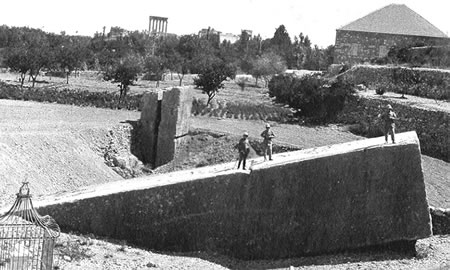
The complex's defining feature is the Temple of Jupiter, the largest religious edifice in the Roman world, elevated on a massive podium incorporating the Trilithon—three limestone blocks each weighing approximately 800 tons, quarried nearby and positioned with precision that underscores Roman mastery of megalithic construction techniques using levers, rollers, and earthen ramps. Scholarly analysis, including archaeoastronomical alignments and epigraphic evidence like graffiti dated to AD 60, confirms the temple's initiation shortly after the Augustan colony's establishment and substantial completion by the mid-1st century AD, countering unsubstantiated claims of pre-Roman origins for the foundation layers despite the site's earlier Phoenician settlement traces.
Beyond its architectural grandeur, Baalbek's significance lies in its role as a syncretic sanctuary blending local Semitic cults with Greco-Roman deities, attracting pilgrims and emperors like Septimius Severus, who expanded it in the early 3rd century AD. The enduring mystery of transporting and erecting the site's quarried monoliths—such as the unfinished 1,200-ton "Stone of the Pregnant Woman"—has fueled debates on ancient logistics, yet experimental archaeology and historical accounts affirm feasibility through organized labor and mechanical ingenuity rather than extraordinary or extraterrestrial intervention.
Etymology
Historical Names and Linguistic Origins
The name Baalbek originates from Semitic languages spoken in the ancient Near East, particularly Canaanite and Phoenician dialects, where Baʿal denotes the deity Baal, a Semitic god associated with storms, fertility, and kingship, often translated as "lord." The second element, bek or bēq, is widely interpreted as a reference to the Bekaa Valley (Biqaʿ), the geographic region encompassing the site, yielding a meaning of "Baal of the Bekaa" or "Lord of the Valley." This etymology, proposed by scholars such as E.A. Cook in the 19th century, reflects the site's role as a cult center for Baal (equated with Hadad) amid the fertile valley, though some interpretations suggest bek could imply "spring" or "brook" from Semitic nafaqa, linking to local water sources.
 During the Hellenistic period following Alexander the Great's conquests around 333 BCE, the city adopted the Greek name Heliopolis (Ἡλιούπολις), meaning "City of the Sun," likely due to syncretic associations between Baal-Hadad and solar or celestial deities, or possibly reflecting the prominence of a solar cult in the region. This name persisted into the Roman era as a Latinized form, emphasizing the site's transformation into a major sanctuary under imperial patronage, distinct from the earlier Semitic toponym. The shift underscores linguistic Hellenization in the Levant, where local Semitic names coexisted with imposed Greek equivalents without fully supplanting them.
Pre-Hellenistic attestations of the name are scarce, with no definitive mentions in Egyptian or Mesopotamian records under a variant form, though the site's Bronze Age occupation suggests continuity in local Semitic nomenclature tied to Baal worship. The modern Arabic rendering Baʿlabakk (بَعْلَبَكّ) preserves the ancient Semitic structure, adapted through Aramaic and Syriac influences, confirming phonological evolution from Phoenician roots without evidence of borrowing from Greek or later languages. Debates on the exact demarcation between Baʿal as divine title versus proper name highlight the fluidity of Semitic theophoric compounds, but empirical toponymy supports the valley-god linkage over speculative alternatives like "crying Baal" from Hebrew puns.
Transition to Roman Heliopolis
The transition from local Semitic worship centers to Roman Heliopolis commenced with Pompey the Great's annexation of Syria in 64 BCE, integrating Baalbek into the Roman province and subjecting it to imperial administration. Although Mark Antony temporarily granted the territory to Cleopatra VII in 38 BCE, restoring Ptolemaic influence, Roman control was reasserted under Augustus following the Battle of Actium in 31 BCE. The Hellenistic name Heliopolis ("City of the Sun"), already in use since the Ptolemaic era and reflecting syncretic links between the local storm god Ba'al-Hadad and solar deities—possibly influenced by Egyptian Heliopolis—was retained and formalized by Romans, who equated Ba'al with Jupiter Heliopolitanus to align indigenous cults with imperial religion.
Under Augustus (r. 27 BCE–14 CE), Heliopolis gained colonial privileges as part of the Colonia Julia Augusta Felix Berytus established circa 15 BCE near modern Beirut, with Roman veterans settled in the Bekaa Valley to secure the frontier and promote Romanization; this included infrastructure like roads and aqueducts supporting the site's strategic fertility and religious prominence. The sanctuary's expansion began in the late 1st century BCE, initiating the massive Temple of Jupiter complex on a grand podium, symbolizing Rome's investment in local legitimacy through monumental architecture that blended Eastern and classical elements. Full independence as Colonia Heliropolitana Iulia Augusta Felix was granted in 194 CE by Septimius Severus after his defeat of Pescennius Niger, elevating its status amid the Severan dynasty's favoritism toward eastern provinces and further entrenching its role as a cult center for the Heliopolitan triad.
Geography
Location and Topography
Baalbek lies in the Beqaa Valley of eastern Lebanon, serving as the administrative center of the Baalbek-Hermel Governorate. Its geographic coordinates are approximately 34°00′N 36°13′E, positioning it about 85 kilometers northeast of Beirut and near the foothills of the Anti-Lebanon Mountains east of the Litani River.
The archaeological site occupies an elevation of 1,150 meters above sea level, situated at the foot of the southwestern slope of the Anti-Lebanon range. This placement within the broader Beqaa Valley places Baalbek in a region characterized by relatively flat, arable terrain formed by rift valley dynamics, with the valley floor averaging around 1,000 meters in height.
Topographically, Baalbek's temple complex is elevated on a large mound or tell, which provided a strategic and visually dominant position amid the surrounding plain. The Beqaa Valley itself is hemmed in by the Lebanon Mountains to the west and the Anti-Lebanon Mountains to the east, creating a corridor of fertile alluvial soils conducive to agriculture, though the site's immediate environs feature gentler slopes transitioning to steeper mountain flanks. This topography influenced ancient settlement patterns, offering defensibility and access to water sources like the nearby springs and rivers.
Climate and Environmental Factors
 Baalbek lies in Lebanon's Bekaa Valley, which features a continental variant of the Mediterranean climate, marked by pronounced seasonal contrasts: hot, arid summers and cooler, relatively wet winters with occasional snowfall. Average annual precipitation totals around 431 mm, concentrated primarily from November to March, while summers from June to August receive negligible rainfall, fostering dry conditions that support agriculture reliant on irrigation. Mean annual temperatures hover near 14–18°C, with July and August highs averaging 29°C (84°F) and January lows dipping to 5–10°C, sometimes below freezing, influencing vegetation patterns and historical settlement viability.
The region's environmental profile includes limestone-dominated geology prone to karst features and seismic activity, compounded by soil erosion driven by steep topography, intense winter rains, and reduced vegetative cover, which accelerates land degradation across the Bekaa. Water scarcity emerges as a key factor, with recurrent droughts—intensified by climate variability—reducing groundwater recharge and surface flows in the Litani River basin, historically critical for the valley's fertility and the Baalbek site's subterranean aqueducts. These dynamics contribute to salinization and nutrient loss in soils, limiting arable land to about 20–30% of the area without intervention.
Preservation of Baalbek's archaeological structures faces amplified risks from these factors, including freeze-thaw cycles causing stone fracturing and wind-driven abrasion eroding trilithon blocks, alongside broader anthropogenic pressures like urban encroachment that exacerbate runoff-induced erosion. Recent trends, including a 1.8°C temperature rise since the mid-20th century and shifting precipitation toward more erratic, torrential events, heighten vulnerability to flash floods and dust accumulation on monuments, as documented in regional assessments. Efforts to mitigate include UNESCO-guided buffer zone planning to curb incompatible development and maintain hydrological balance.
History
Prehistoric and Bronze Age Foundations
Archaeological investigations at Tell Baalbek, the mound underlying the later Roman temple complex, have uncovered stratigraphic evidence of continuous human occupation beginning in the Neolithic period, with layers spanning from the Pre-Pottery Neolithic B (approximately 8500–7000 BCE) to subsequent phases. These early traces include lithic tools and settlement debris indicative of small-scale agricultural or semi-sedentary communities exploiting the fertile Bekaa Valley. Chalcolithic remains from the fourth millennium BCE, characterized by copper tools and pottery precursors, further attest to persistent low-density habitation on the tell, likely tied to local resource extraction and proto-urban networks in the Levant.
Transitioning into the Bronze Age, excavations reveal stratified deposits from the Early Bronze Age (c. 3300–2000 BCE), including rudimentary architecture and ceramics linked to Canaanite material culture, suggesting the site functioned as a modest village amid broader regional trade routes. Middle Bronze Age (c. 2000–1550 BCE) layers yield more diagnostic pottery, such as wheel-thrown vessels and storage jars unearthed in the Great Courtyard beneath the Temple of Jupiter, pointing to fortified settlements and possible cultic activity associated with early Semitic deities. Late Bronze Age (c. 1550–1200 BCE) evidence is sparser but includes imported Mycenaean sherds, implying peripheral involvement in Egyptian-influenced Canaanite exchange systems, though Baalbek itself remains unmentioned in Amarna letters or other cuneiform records.
These foundations laid a substratum for later monumental development, with the tell's elevated position and quarriable limestone likely influencing site selection for enduring cultic or communal purposes. However, the absence of textual references underscores Baalbek's role as a secondary settlement compared to coastal or southern Canaanite centers like Byblos or Megiddo, where denser populations and fortifications prevailed. Pre-Roman layers were largely obliterated or repurposed during imperial construction, limiting comprehensive reconstruction of social organization or economy to ceramic typologies and limited faunal remains.
Phoenician and Canaanite Periods
 Baalbek, situated in the Beqaa Valley, exhibits evidence of occupation dating to the Early and Middle Bronze Ages (circa 3000–2000 BCE), marking its role as a Canaanite religious center dedicated to Baal (Hadad), the storm and fertility deity central to Semitic pantheons. The site's etymology, rooted in Phoenician-Canaanite terms such as yarkab ləbaʿal ("Baal of Weeping") or ʿayin yarkab ("Spring of Weeping"), points to ritual practices involving ceremonial mourning for Baal's mythical death and resurrection, paralleling Ugaritic texts like the Baal Cycle (KTU 1.5–1.6). These toponyms, preserved in rabbinic literature and linked to biblical references such as the "Valley of Aven" (Amos 1:5), underscore Baalbek's identity as nwat qob ("Valley of Idolatry"), a locale for Baal worship potentially extending to the god Il as an abode (mbk nhrm).
Archaeological findings, though limited due to overlay by Roman structures, include Bronze Age pottery and settlement traces confirming continuous habitation, with the sanctuary likely comprising a raised platform and altar consistent with Canaanite temple architecture at sites like Ugarit. A sacred spring at Rās el-ʿAyn, featuring semicircular niches, supplied ritual water, integrating natural topography into cultic activities that may have involved processions and offerings to Baal-Hadad for agricultural fertility in the fertile valley.
Transitioning into the Phoenician Iron Age (circa 1200–539 BCE), Baalbek maintained its status as a Baal sanctuary amid city-state networks, benefiting from its position on trade routes between the Mediterranean coast and inland Syria. Continuity in worship is inferred from the persistence of Semitic naming conventions and the absence of disruptive conquest evidence until Assyrian incursions around 850 BCE, which imposed tribute but preserved local cults. Phoenician expansions likely enhanced the site's infrastructure, though no monumental pre-Roman edifices have been fully excavated, highlighting interpretive challenges posed by later Hellenistic and Roman refurbishments that syncretized Baal with solar deities.
Hellenistic and Early Roman Integration
 Following the conquests of Alexander the Great in 332 BCE, the region encompassing Baalbek fell under Hellenistic control as part of the successor states to his empire, initially contested between the Ptolemies of Egypt and the Seleucids of Syria. The site, already a local sanctuary for a Phoenician triad of deities including Baal, underwent cultural syncretism, with Baal equated to solar gods such as the Egyptian Ra under Ptolemaic influence and later Helios under the Seleucids. This period saw the adoption of the Greek name Heliopolis ("City of the Sun"), reflecting the emphasis on solar worship, though archaeological investigations reveal only modest settlement remains—such as ceramics and basic structures—indicating Baalbek functioned as a minor rural cult center rather than a major urban or architectural hub. No evidence of large-scale Hellenistic temples or fortifications has been uncovered, suggesting continuity from earlier Canaanite-Phoenician traditions without significant Greek-style monumental development.
The Seleucid hold solidified after Antiochus III's defeat of Ptolemaic forces at the Battle of Paneion in 200 BCE, maintaining Baalbek as a peripheral possession until the dynasty's collapse. Hellenistic governance emphasized cultural Hellenization through Greek settlements and administrative practices across Syria, but Baalbek's remote Bekaa Valley location limited its integration into broader networks like those of Antioch or Apamea.
In 64 BCE, Roman general Gnaeus Pompeius Magnus annexed the remnants of Seleucid Syria, incorporating Heliopolis into the new province of Syria without recorded resistance or destruction at the site. This marked a seamless administrative transition, with Roman rule preserving the Hellenistic religious framework: the local triad was reinterpreted as Jupiter Heliopolitanus (syncretized with Baal-Helios), Venus, and Mercury, allowing continuity of pilgrimage and offerings while subjecting the area to provincial taxation and military oversight. Early Roman integration involved no immediate veteran colonies or radical restructuring, as evidenced by the absence of Republican-era coins or inscriptions specific to Heliopolis; instead, the site's strategic position in the fertile Bekaa facilitated gradual Romanization through trade routes linking coastal Berytus (Beirut) to inland Syria. By the late Republic and early Empire, this laid the groundwork for imperial patronage, though full colonial status—Colonia Heliopolis—is attested only under Septimius Severus around 200 CE, per the jurist Ulpian. Archaeological layers show incremental Roman deposits overlying Hellenistic ones, confirming peaceful overlay rather than conquest-driven rebuilds.
Imperial Roman Construction and Peak
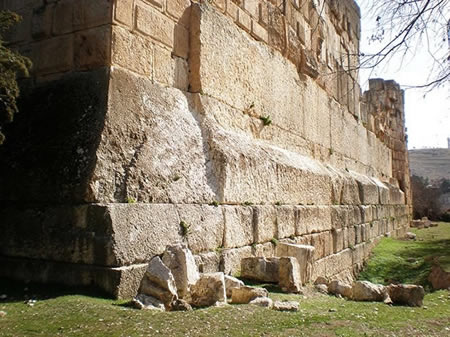 The Roman transformation of Baalbek into Heliopolis began following Pompey's conquest of the region in 64 BC, integrating it into the province of Syria. Construction of the monumental sanctuary accelerated under Augustus, who established the colony Colonia Julia Augusta Felix Heliopolis around 27 BC, settling veterans and initiating major building projects, including the foundational platform for the Temple of Jupiter. This platform, elevated on a massive podium, incorporated enormous limestone blocks, with three megaliths in the trilithon layer each weighing over 800 tons, quarried and positioned during the early imperial phase to support the temple complex.
The Temple of Jupiter itself, dedicated to the supreme deity of the Heliopolitan triad, underwent primary construction phases from the late 1st century BC, with significant advancements under Nero (r. 54–68 AD), who oversaw the near-completion of the shrine by circa 60 AD. Measuring approximately 88 meters in length and 48 meters in width, the temple featured 54 Corinthian columns rising 20 meters high, enclosing a cella and surrounded by a peristyle, making it one of the largest Roman temples ever built. Subsequent emperors contributed: Trajan (r. 98–117 AD) advanced the structure during his eastern campaigns, while Antoninus Pius (r. 138–161 AD) initiated the expansive Great Court, a hexagonal forecourt with porticos and exedrae, enhancing the site's role as a pilgrimage hub.
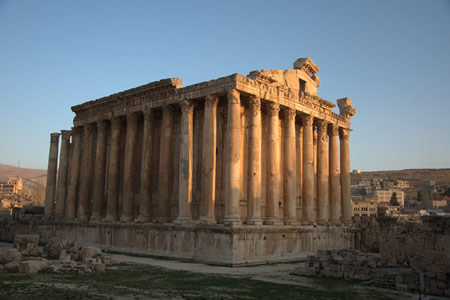
Parallel developments included the Temple of Bacchus, constructed primarily under Antoninus Pius in the mid-2nd century AD, renowned for its intricate friezes depicting Bacchic rituals and measuring 66 meters by 35 meters with 42 columns. The smaller, circular Temple of Venus, attributed to the same era, exemplified refined Hellenistic influences with its ornate podium and niches. By the early 3rd century AD, under Septimius Severus (r. 193–211 AD), final embellishments reflected the site's peak prosperity, as Heliopolis flourished economically from temple revenues, trade, and imperial patronage, drawing worshippers empire-wide to the triad of Jupiter, Venus, and Mercury. All visible monumental architecture dates to the Roman imperial period, with no pre-Roman stones identifiable in the superstructure.
Late Antiquity and Byzantine Transition
 During the 4th century AD, as Christianity became the dominant religion under Emperor Constantine I (r. 306–337), Heliopolis (Baalbek) saw the construction of a Christian basilica, likely involving the adaptation of existing pagan temple structures within the sanctuary complex; this basilica was placed under the care of a local bishop and supporting clergy. A brief pagan revival occurred under Emperor Julian (r. 361–363), who reopened the temples for worship, but this ended abruptly with his death in battle, after which Emperor Theodosius I (r. 379–395) issued edicts suppressing pagan practices empire-wide, leading to the definitive closure of Heliopolis's temples and their gradual repurposing for Christian use.
In the ensuing Byzantine period (5th–7th centuries), Heliopolis transitioned into a Christian episcopal see, with the temple precincts—particularly elements of the Temple of Jupiter—converted into churches, such as one dedicated to the Virgin Mary, which helped preserve the monumental architecture from outright destruction amid the empire's Christianization efforts. The city maintained administrative and religious significance in the province of Phoenicia Libanensis, though it faced recurrent seismic damage from regional earthquakes, including severe events in 346 AD and 551 AD that affected the Bekaa Valley and surrounding structures.
The late Byzantine era culminated in external invasions marking the shift away from imperial Roman-Christian control: Sassanid Persian forces under Khosrow II captured Heliopolis around 614 AD during their broader conquest of Syria and Palestine, holding it until Byzantine recapture in 628 AD under Heraclius. This unstable interlude preceded the Arab Muslim conquest; in 636–637 AD, Heliopolis surrendered to the Rashidun Caliphate's armies led by Khalid ibn al-Walid with minimal resistance, as local garrisons, including 2,000 Baalbek soldiers dispatched elsewhere, offered little opposition, initiating the site's integration into early Islamic rule and the decline of its Byzantine Christian character.
Early Islamic and Medieval Eras
Baalbek fell to Arab Muslim forces in 636 CE, shortly after the Battle of Yarmouk, during the conquest of Byzantine Syria under the Rashidun Caliphate. The city, then known as Heliopolis, transitioned into Islamic rule as part of the expanding caliphal territories, with its strategic location on trade routes contributing to its continued significance.
Under the Umayyad Caliphate (661–750 CE), Baalbek formed part of the Damascus district and experienced urban development, including the construction of a major mosque around 714–715 CE by Caliph al-Walid I, which incorporated spolia from Roman temples. This period marked relative prosperity, with the city serving as a key node in Bilad al-Sham, though specific administrative details remain sparse in surviving records. The Abbasid era (750–1258 CE) saw continuity in this role, maintaining Baalbek as an urban center along major thoroughfares connecting northern and southern regions of greater Syria.
The Fatimids conquered Baalbek in 942 CE, integrating it into their Egyptian-based domain and further emphasizing its position amid Shi'i-Isma'ili governance. Mid-10th-century descriptions highlight the city's architectural splendor, including marble-sculpted palace gates and tall columns, underscoring its enduring appeal despite shifting dynastic controls.
In the 11th–13th centuries, Baalbek became embroiled in regional conflicts between Muslim rulers and Crusader forces, though it was not a primary Crusader stronghold; Zengid atabeg Imad al-Din Zengi besieged and captured it in 1139 CE as part of campaigns against Frankish expansions. The citadel functioned as a prison for Crusader captives under Zengid and subsequent Ayyubid oversight. Under Mamluk rule (1250–1517 CE), fortifications were reinforced, with remnants of these defenses visible alongside a medieval mosque, reflecting the site's adaptation for military purposes amid Mongol threats and internal power struggles. Baalbek's Roman ruins, while quarried for building materials, persisted as a backdrop to this era's transformations, with local traditions attributing ancient origins to biblical figures like Solomon.
Ottoman Administration
Following the Ottoman conquest of the Mamluk Sultanate in 1516, Baalbek was administered as the Sanjak of Baalbek within the Damascus Eyalet of the Ottoman Empire, encompassing the surrounding Beqaa Valley region. Local governance was largely delegated to Shiite emirs of the Harfush family, who emerged as prominent intermediaries in the late 16th century and controlled Baalbek as a semi-autonomous district, managing tax collection and maintaining order amid a mixed population of Metaweli Shiite Muslims and Christians. The Harfushes' authority, rooted in tribal alliances and Ottoman recognition, persisted through the 17th and 18th centuries, during which the ancient Roman ruins were largely neglected, serving occasionally as quarries for local construction, including mosques that incorporated salvaged columns and stones.
Ottoman interest in Baalbek's antiquities manifested sporadically, as evidenced by 17th-century scholarly visits, such as that of the Damascene traveler ʿAbd al-Ghanī al-Nābulusī, who documented the ruins and interpreted them through Islamic historical lenses, reflecting an emerging antiquarian tradition within the empire. The area functioned as a minor administrative outpost, overshadowed by larger centers like Damascus and Aleppo, with limited central oversight allowing local dynamics to dominate.
In the mid-19th century, amid Tanzimat reforms aimed at centralization, Ottoman authorities dismantled Harfush emirate structures and imposed direct rule around 1850, elevating Baalbek to kaza status under the Damascus Eyalet, with a kaymakam as local governor responsible for judicial and fiscal affairs. This shift coincided with gradual European archaeological attention, though the site remained sparsely populated and economically marginal until the empire's collapse in 1918.
French Mandate and Independence
In 1920, French High Commissioner Henri Gouraud proclaimed the State of Greater Lebanon, incorporating the Bekaa Valley—including Baalbek—into its boundaries as part of the Mandate for Syria and Lebanon, thereby separating these eastern districts from Syrian administration centered in Damascus. This delineation, driven by French strategic interests to bolster a viable Christian-majority state with agricultural hinterlands, faced resistance from Syrian nationalists who claimed the Bekaa as historically Syrian territory. Baalbek's ancient Roman ruins, preserved amid the Bekaa's fertile plains, emerged as a nascent symbol of Lebanese identity under this new configuration.
Throughout the Mandate era (1920–1946), French authorities prioritized archaeological preservation at Baalbek, sponsoring missions that conducted excavations, debris clearance, and structural repairs on the temple complex to safeguard its imperial Roman features against decay and illicit removal. These efforts, supervised by figures like Charles Virolleaud, advanced documentation and partial restoration while reinforcing French cultural influence in the region. Early cultural events, such as theatrical performances in the ruins in 1922 and 1944, highlighted the site's potential as a venue for public engagement.
World War II disrupted Mandate governance when Vichy France assumed control in 1940, but the 1941 Allied invasion of Syria and Lebanon—led by British, Australian, and Free French forces under General Georges Catroux—ousted Vichy administration by July. On November 26, 1941, Catroux proclaimed Lebanese independence in the name of Free France, abolishing the Mandate framework, though French military presence and influence persisted. Full sovereignty materialized after the November 1943 parliamentary elections, which adopted a national constitution and prompted France to relinquish special powers; remaining troops departed by December 1946. Baalbek transitioned seamlessly into independent Lebanon as the administrative hub of its namesake district, with its railway station—remnant of Ottoman-era infrastructure—facilitating regional connectivity under sovereign rule.
Lebanese Civil War Involvement
During the Lebanese Civil War (1975–1990), Baalbek and the surrounding Bekaa Valley became a strategic zone under Syrian military control following Damascus's intervention on June 1, 1976, aimed at containing Palestinian Liberation Organization (PLO) expansion and leftist alliances threatening Syrian interests. Syrian forces rapidly advanced into the Bekaa, establishing bases and checkpoints that integrated Baalbek into their operational network, with troop concentrations exceeding 30,000 by the early 1980s to secure supply lines and counter insurgent activities. This occupation minimized large-scale urban battles in Baalbek compared to Beirut but imposed a de facto Syrian administration, including economic oversight and suppression of anti-Syrian militias.
Local dynamics involved Shiite militias rivaling the Amal Movement, with a reported 3,500-strong group based in Baalbek advocating Islamic governance and clashing sporadically with Syrian-backed factions, exacerbating sectarian frictions in the predominantly Shiite region. Palestinian fedayeen maintained training camps in the Bekaa until their partial displacement by Syrian and later Israeli operations, such as the 1982 Israeli invasion that targeted Syrian assets moving from Baalbek southward. Incidents of violence included militia incursions into Baalbek resulting in at least 15 deaths and dozens injured in one documented episode, alongside sniper attacks on Syrian patrols persisting into 1981.
The war's militarization halted archaeological preservation at Baalbek's Roman temples, diverting resources to conflict and causing infrastructural neglect, while tourism ceased amid regional instability. Syrian dominance in the Bekaa endured until the late 1980s, facilitating arms flows and proxy engagements but also stabilizing the area relative to western Lebanon, though at the cost of local autonomy and economic stagnation.
Post-1989 Reconstruction and Hezbollah Ascendancy
Following the Taif Agreement of October 1989, which formally ended Lebanon's 15-year civil war, Baalbek entered a phase of stabilization under heavy Syrian military and political influence in the Bekaa Valley, where Syrian forces were deployed to enforce the accord's provisions. The town's Roman archaeological complex, inscribed as a UNESCO World Heritage Site in 1984, had sustained minimal direct damage from the conflict, allowing preservation and minor restoration efforts to resume in the early 1990s, including site maintenance to bolster limited tourism recovery. Infrastructure reconstruction in Baalbek and surrounding areas lagged behind Beirut's centralized initiatives under Prime Minister Rafik Hariri, with Bekaa projects hampered by ongoing Syrian oversight, militia disarmament delays, and economic constraints; basic road repairs and agricultural support predominated over large-scale urban renewal.
Hezbollah, backed by Iran and aligned with Syria, capitalized on the post-war power vacuum in Shia-majority Baalbek to expand its influence, transitioning from a primarily militant entity to a hybrid political-social force. In Lebanon's 1992 parliamentary elections—the first since 1972—Hezbollah secured 12 seats nationwide, including strong representation from the Baalbek district through alliances with Amal, establishing electoral dominance in the Bekaa. This political foothold complemented its military consolidation, with training camps in the Bekaa Valley serving as bases for operations against Israeli forces in southern Lebanon until the 2000 withdrawal.
Hezbollah's ascendancy accelerated through an extensive parallel welfare system, addressing state shortcomings in a region neglected by central authorities. Organizations like Jihad al-Bina', a Hezbollah-affiliated construction entity, undertook infrastructure projects in Baalbek, including the 1999 establishment of the Sayyid Abbas Al-Mussawi Center for community development, alongside schools, clinics, and agricultural aid that reached thousands of Shiite residents. These services, funded partly by Iranian support and local fundraising, fostered dependency and loyalty, enabling Hezbollah to embed itself as a de facto authority in Baalbek by the late 1990s, often resisting full integration with Lebanese state institutions. This model of "resistance" governance, combining social provision with armed presence, solidified Hezbollah's control amid Syria's tolerance, positioning Baalbek as a key northern stronghold.
2006 Lebanon War and Aftermath
On August 1, 2006, during the 2006 Lebanon War, Israeli Air Force jets conducted airstrikes on targets in Baalbek, a known Hezbollah stronghold in Lebanon's Bekaa Valley, prior to a ground commando raid. The Israel Defense Forces (IDF) identified the Dar al-Amal Hospital and surrounding areas as housing a Hezbollah command center and weapons stockpiles, including long-range rockets; Hezbollah officials denied these claims, asserting the sites were civilian. The operation, codenamed Sharp and Smooth, involved over 100 IDF troops airlifted into the city, resulting in the confirmed deaths of five Hezbollah fighters, the capture of weapons caches, and an estimated 10-23 civilian casualties from the preceding airstrikes, though exact figures vary by reporting. No high-ranking Hezbollah leaders were killed or captured, as initially anticipated by Israel, leading to assessments that the raid disrupted local operations but did not decapitate command structures.
The Baalbek archaeological site, a UNESCO World Heritage property, experienced negligible direct damage from the strikes, with a September 2006 UNESCO assessment noting only the dislodgement of a single stone block from the ancient structures. Broader war impacts included the destruction of nearby bridges, roads, and residential areas in the Bekaa region, displacing thousands of locals and severing access to Baalbek. Hezbollah's provision of humanitarian aid, including shelter and reconstruction materials, in the immediate post-ceasefire period bolstered its local support base in the Shia-majority city.
Following the UN-brokered ceasefire on August 14, 2006, Baalbek saw partial infrastructure rebuilding funded by Lebanese government and international donors, though Hezbollah's parallel networks handled much of the local recovery, reinforcing its political dominance in the area. Tourism to the Roman ruins, a key economic driver, plummeted during the conflict but began recovering by 2007, albeit constrained by ongoing security concerns and Hezbollah's military presence, which deterred some international visitors. The war's legacy in Baalbek included heightened sectarian tensions and entrenched Hezbollah influence, with the group maintaining operational freedom in the Bekaa Valley despite UN Resolution 1701's calls for disarmament.
2024-2025 Escalations with Israel
In late October 2024, as part of the escalating Israel-Hezbollah conflict, the Israeli military issued evacuation orders for Baalbek and surrounding areas in Lebanon's Bekaa Valley, citing the presence of Hezbollah command-and-control centers and infrastructure. On October 30, 2024, Israeli airstrikes targeted these sites in Baalbek, resulting in at least 19 deaths according to Lebanon's Health Ministry. The strikes marked a significant expansion of operations into eastern Lebanon, a region previously spared major bombardment, prompting tens of thousands of residents to flee, with some seeking shelter amid the ancient Roman temples.
Further airstrikes in early November 2024 intensified the campaign, with Lebanese health officials reporting 40 deaths and 53 injuries from attacks on Baalbek and the broader Bekaa Valley on November 6. The Israeli Defense Forces stated these operations focused on Hezbollah military assets, including weapon storage and production facilities embedded in civilian zones. Baalbek's status as a Hezbollah stronghold in the Bekaa—where the group maintains significant operational depth and recruitment—drove the targeting, despite the city's UNESCO-listed archaeological significance and dense population of over 30,000.
The conflict persisted into 2025 amid stalled ceasefire efforts, with Israeli strikes continuing against Hezbollah targets in the Baalbek-Hermel region. On August 7, 2025, airstrikes in eastern Lebanon killed at least six people, including in areas near Baalbek. By October 22, 2025, further bombings in Baalbek claimed two lives, targeting a Hezbollah camp and precision missile production site, as confirmed by the Israeli military. These actions reflected Israel's strategy to degrade Hezbollah's capabilities beyond southern Lebanon, though they displaced additional civilians and strained local infrastructure in a valley already hosting over a million Syrian refugees. Lebanese reports of casualties, often sourced from Hezbollah-aligned health networks, consistently exceeded Israeli acknowledgments, highlighting discrepancies in verification amid restricted access to strike sites.
Demographics
Population Statistics and Composition
The town of Baalbek is estimated to have a population of 30,916 residents based on 2023 projections derived from United Nations data and local surveys. Lebanon's lack of an official national census since 1932 contributes to reliance on such estimates, which account for factors like migration, conflict-related displacement, and refugee influxes but remain subject to variance across sources. The surrounding Baalbek District, administrative capitaled by the town, had an estimated 387,935 inhabitants as of 2017, reflecting a density of approximately 167 persons per square kilometer across its 2,319 km² area.
Demographic composition in Baalbek is dominated by Shiite Muslims, who form the clear majority of the local population, consistent with patterns in the Baalbek-Hermel Governorate where Shiites predominate alongside minority pockets of Sunnis and Christians. Christians, primarily Greek Orthodox and Melkite Greek Catholics, constitute a small but historically present community, while Sunnis represent a further minority often linked to adjacent areas. Ethnically, the residents are overwhelmingly Arab Lebanese, with negligible non-Arab minorities; this mirrors the Bekaa Valley's broader homogeneity, though the presence of Syrian refugees—estimated at over 137,000 in the governorate as of 2015—has temporarily altered transient demographics without significantly impacting core sectarian balances. Gender distribution in the town approximates 51% male and 49% female, per localized projections. Recent escalations, including the 2024-2025 Israel-Hezbollah conflict, have prompted outflows, potentially reducing effective residency figures below pre-crisis estimates, though comprehensive post-2024 data remains unavailable.
Religious and Sectarian Dynamics
Baalbek's population is predominantly Shiite Muslim, forming the majority in the Baalbek-Hermel Governorate, with smaller pockets of Sunni Muslims and Christians, including Greek Orthodox and Maronite Catholics. This sectarian composition reflects broader patterns in Lebanon's Bekaa Valley, where Shiites constitute the largest group amid a mix of religious communities.
Hezbollah maintains a dominant political and social influence in Baalbek, positioning the city as a core stronghold and recruitment base for the Iran-backed Shiite organization, which leverages tribal networks and economic patronage among local Shiites. This dominance is rooted in historical events, such as the massing of approximately 5,000 Hezbollah fighters in Baalbek in mid-1986 during a public demonstration of strength.
Sectarian relations in Baalbek remain relatively stable compared to Lebanon's coastal or southern flashpoints, with inter-communal cooperation evident during crises, such as Christians in nearby Deir al-Ahmar sheltering displaced Shiites amid 2024 Israeli strikes targeting Hezbollah infrastructure. However, underlying tensions arise from Hezbollah's prioritization of resistance activities over local development, exacerbating economic grievances that disproportionately affect non-Shiite minorities and fostering resentment tied to national confessional power-sharing imbalances. Historical precedents, including 19th-century Druze-Christian clashes spilling into the Bekaa, underscore potential volatility, though contemporary dynamics are more subdued, constrained by Hezbollah's de facto control.
Economy
Traditional Agriculture and Local Trade
The Baalbek region's traditional agriculture centers on the fertile soils of the Bekaa Valley, where smallholder farming predominates with rain-fed and irrigated cultivation of grains, vegetables, and fruits. Principal crops include wheat and barley for cereals, potatoes and alfalfa for fodder, alongside orchards of apples, cherries, apricots, grapes, and olives, which have sustained local communities for generations through seasonal planting and manual harvesting techniques. Livestock rearing, focused on sheep and goats for milk, meat, and wool, integrates with crop farming via agro-pastoral systems, utilizing valley pastures and crop residues as feed. These practices rely on natural water sources like the al-Assi River and traditional qanats for irrigation, though yields remain modest due to limited mechanization and soil variability.
Local trade revolves around weekly souks in Baalbek and nearby Hermel, where farmers barter or sell produce directly to consumers and small traders, emphasizing fresh fruits, vegetables, dairy products, and grains for household consumption and regional distribution. Transport occurs via informal networks of pickup trucks to markets in Zahle or Beirut, but poor road infrastructure and checkpoint delays constrain volumes, favoring subsistence over commercial scale. Artisanal processing, such as olive pressing for oil or grape distillation for arak, supports ancillary trade, with products exchanged for essentials like tools and fuel. Despite these patterns, illicit cultivation of cannabis—historically intertwined with legitimate farming in the Baalbek-Hermel area—has supplemented incomes through underground networks, though it evades formal trade channels and faces periodic eradication efforts.
Tourism and Cultural Heritage Revenue
Baalbek's Roman temple complex, a UNESCO World Heritage site since 1984, draws visitors primarily for its monumental architecture, contributing to local revenue through site entrance fees, licensed guides, transportation services, and nearby hospitality establishments. In 2023, the site hosted approximately 70,000 international tourists alongside 100,000 domestic Lebanese visitors, supporting seasonal employment in tourism-related sectors amid Lebanon's broader economic challenges.
The Baalbek International Festival, held annually at the ancient ruins, supplements cultural heritage revenue by attracting performers and audiences, with past editions featuring international artists and generating income from ticket sales that partially funds site maintenance. However, persistent security concerns, including Hezbollah's regional influence and proximity to conflict zones, have historically limited tourist inflows compared to Lebanon's coastal sites.
Escalating hostilities in 2024, particularly Israeli strikes targeting Hezbollah infrastructure near Baalbek, reduced visitation to roughly 5% of 2023 levels by October, exacerbating revenue losses in an already strained local economy. Lebanon's national tourism arrivals fell 32% year-over-year to 1.13 million in 2024, reflecting the compounded impact on heritage-dependent sites like Baalbek, where visitor spending typically bolsters agriculture and trade in the Bekaa Valley. Overall, while cultural tourism provided $5.4 billion to Lebanon's receipts in 2023—equivalent to a significant GDP share—Baalbek's contribution remains modest and volatile, reliant on regional stability for sustained economic viability.
Security Impacts on Economic Activity
Security threats in Baalbek, stemming from its location in Hezbollah's Bekaa Valley stronghold and recurrent Israel-Hezbollah conflicts, have profoundly disrupted local economic activity, particularly tourism, which constitutes a primary revenue source alongside agriculture. The 2024 escalations, including Israeli airstrikes and evacuation orders targeting the city on November 1, 2024, led to the cancellation of summer festivals at the Roman ruins—events that typically attract thousands of international and domestic visitors—resulting in a near-total halt of tourism. Hotels such as the Palmyra, historically bustling during peak seasons, reported zero occupancy since the conflict's intensification in September 2024, while souks and shops in Baalbek's old city remained largely shuttered, exacerbating income losses for vendors and service providers.
Agriculture, a backbone of the Bekaa Valley economy including Baalbek, faced indirect but severe setbacks from heightened insecurity, including disrupted supply chains, labor shortages due to displacement, and risks to farmland from proximity to conflict zones. While direct strikes in Baalbek were limited as of late 2024, the broader war contributed to over US$1 billion in national agricultural losses from destroyed crops, burned orchards, and impaired harvesting, with Bekaa's fertile lands vulnerable to cross-border tensions and internal militia activities. Security advisories from multiple governments, citing terrorism risks and potential strikes, further deterred investment and trade, compounding Lebanon's overall economic contraction estimated at 10-25% for 2024, with tourism and agriculture bearing 77% of losses in affected regions.
Long-term, persistent Hezbollah dominance in Baalbek has entrenched a cycle of volatility, as the group's military posture invites retaliatory actions, stifling foreign direct investment and local entrepreneurship beyond subsistence farming and informal trade. World Bank assessments post-2024 conflict pegged total damages at US$8.5-14 billion nationwide, with Baalbek's UNESCO-listed site's accessibility curtailed by evacuation fears, potentially eroding cultural heritage revenue for years. These dynamics underscore how securitized environments, rather than isolated events, perpetuate economic stagnation, with recovery contingent on de-escalation and governance reforms to mitigate militia-induced risks.
Archaeological Site
Temple of Jupiter Complex
The Temple of Jupiter Complex, the principal sanctuary within the Baalbek site, was dedicated to Jupiter Optimus Maximus Heliopolitanus, the Roman adaptation of the local Semitic deity Baal. Construction spanned over two centuries, commencing in the late 1st century BC during the reign of Augustus and extending into the 3rd century AD under emperors such as Trajan, Hadrian, and Caracalla. This period aligns with Baalbek's designation as Colonia Julia Augusta Felix Heliopolitana, reflecting its status as a key imperial religious center in the province of Syria.
The layout encompasses a vast raised platform measuring approximately 335 meters in length and 134 meters in width, elevated 8 meters above the surrounding terrain. Access proceeds through the Propylaea, a colonnaded entrance hall, into a hexagonal forecourt surrounded by porticos, culminating in the main temple podium. This podium features multiple courses of massive limestone blocks, including 24 monoliths in the terrace walls, with the largest exceeding 800 metric tons. Prominently, the southwestern retaining wall incorporates the Trilithon, comprising three precisely fitted blocks each estimated at 800-1000 metric tons, dimensions of 19-21 meters in length, 4.3 meters in height, and 3.6 meters in thickness. These were quarried from the adjacent Hajjar el-Hibla site and positioned without mortar, demonstrating advanced Roman quarrying and placement techniques feasible with levers, ramps, and capstans as evidenced by comparative engineering analyses.
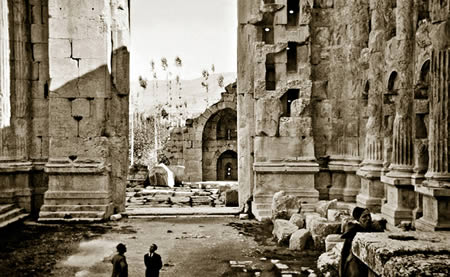
Atop the podium stood the peripteral hexastyle temple, featuring a double row of 54 Corinthian columns—10 across the facade and 19 along the flanks—originally 19.9 meters tall with a 2.5-meter diameter, the largest monolithic columns known from antiquity, sourced from Egyptian granite. The cella measured roughly 88 by 48 meters, designed to enclose a cult statue, though the roof and much of the superstructure were lost to seismic events in 1759 and 1837, with materials repurposed in medieval and Ottoman structures. Surviving elements include six intact columns with entablature, underscoring the complex's scale and the logistical prowess required for transporting and erecting components over distances up to 900 meters from the quarry.
Archaeological excavations reveal the podium's integration of pre-Roman substrates, yet stylistic and inscriptional evidence attributes the visible architecture to Roman phases, with no definitive proof of non-Roman megalithic origins for the Trilithon layer. The complex's orientation and astronomical alignments suggest deliberate site selection for ritual purposes, reinforcing its function as a pilgrimage hub drawing devotees from across the empire.
Temple of Bacchus
The Temple of Bacchus, dedicated to the Roman god of wine and revelry, forms a key component of the Baalbek archaeological complex in Lebanon's Beqaa Valley, constructed during the Roman imperial period as part of ancient Heliopolis. Built primarily in the 2nd century AD, likely under the patronage of Emperor Antoninus Pius around 150 AD, the temple exemplifies advanced Roman engineering and architectural grandeur, incorporating local limestone quarried nearby into a structure that surpasses the Parthenon in scale. Its completion extended into the late 2nd or early 3rd century, reflecting sustained investment in the site's religious infrastructure amid the province's prosperity.
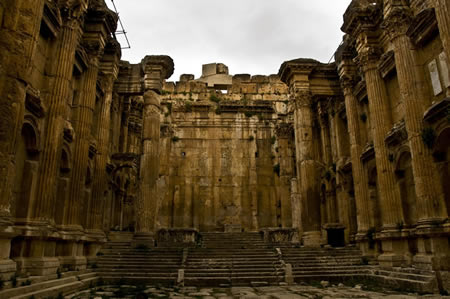
Measuring approximately 69 meters in length, 36 meters in width, and rising 31 meters in height, the temple rests on a raised podium accessed via a monumental staircase flanked by sculptural elements, with its peripteral design featuring 42 Corinthian columns—eight across the facade and nineteen along the sides—adorned with intricate capitals. The cella walls bear elaborate bas-reliefs depicting bacchic themes such as grapevines, thyrsi, and processions of maenads and satyrs, underscoring the deity's cultic associations with fertility and ecstasy, while the entablature includes detailed friezes that integrate Eastern motifs adapted to Roman canons. Construction employed ashlar masonry techniques, with blocks precisely cut and joined without mortar, leveraging the site's megalithic substructure for stability, though the temple's own masonry contrasts with the colossal foundations by using more manageable stones hoisted via cranes and ramps.
Renowned for its exceptional state of preservation compared to the adjacent Temple of Jupiter, the Temple of Bacchus retains much of its superstructure, including over half its columns and significant portions of the entablature, owing to partial conversion into a church during Byzantine times and reduced quarrying post-antiquity. This survival highlights the temple's role in the Heliopolitan triad—complementing Jupiter and Venus—serving as a pilgrimage center that drew devotees for rituals tied to agricultural abundance in the fertile valley. Designated part of Baalbek's UNESCO World Heritage Site in 1984, the temple faces ongoing threats from seismic activity, weathering, and conflict, yet restoration efforts by international bodies have stabilized key elements, preserving it as a testament to Roman provincial architecture's fusion of imperial ambition and local reverence.
Supporting Structures and Quarry
The Baalbek temple complex includes several supporting structures that facilitate access and ritual spaces for the primary temples. The propylaeum serves as the monumental entrance gateway, featuring a facade with columns and statues, leading visitors into the complex. This is followed by the hexagonal forecourt, a unique architectural element with six sides, each approximately 45 meters long, flanked by exedrae and niches for statues, providing a transitional space for ceremonies. Beyond lies the great rectangular court, measuring about 104 meters by 60 meters, enclosed by porticos and containing a central altar tower, which supported communal worship and processions around the Temple of Jupiter. These elements, constructed primarily from local limestone ashlar blocks during the Roman period from the 1st to 3rd centuries AD, elevated the sanctuary on a massive podium incorporating earlier megalithic foundations.
The quarry, known as Hajar el-Hibla or the Quarry of the Pregnant Woman, lies approximately 900 meters southwest of the temple complex and supplied much of the limestone used in construction. It features several unfinished megalithic blocks quarried from the bedrock, with the most prominent being the Stone of the Pregnant Woman, measuring 20.76 meters long, 4 meters wide, and 4.32 meters high, estimated to weigh around 1,000 metric tons. Nearby are two larger monoliths: one weighing approximately 1,200 tons and another, discovered in 2014, estimated at 1,650 tons, both partially detached but abandoned in situ, likely intended for expanding the temple podium. These blocks, cut during the Roman era, demonstrate advanced quarrying techniques involving channeling and wedging, though their precise transport method remains debated among archaeologists. The quarry's output, including smaller blocks for walls and larger ones for foundations, underscores the logistical scale of the site's imperial construction efforts under emperors like Nero and Trajan.
Conservation Efforts and Threats
The Baalbek archaeological site, inscribed as a UNESCO World Heritage property in 1984, is managed by Lebanon's Directorate General of Antiquities (DGA), which oversees all construction, restoration permits, and conservation activities under the Antiquities Law No. 166 of 1933. UNESCO has supported targeted initiatives, including a 2017 technical workshop in Beirut focused on conservation and restoration techniques for Baalbek and the Tyre site. Between 2016 and 2018, a conservation and presentation project addressed a significant portion of the surrounding medieval quarter, funded by international donors and emphasizing the transmission of traditional masonry and modern preservation methods to local craftsmen. In March 2025, UNESCO conducted a rapid damage assessment mission to evaluate the site's condition amid ongoing regional instability.
In November 2024, UNESCO provisionally granted enhanced protection to Baalbek under the 1999 Second Protocol to the Hague Convention for the Protection of Cultural Property in the Event of Armed Conflict, extending this status to 33 other Lebanese sites to deter deliberate targeting and facilitate priority safeguarding during hostilities. This measure responds to the site's vulnerability in a Hezbollah stronghold, where military activities have heightened risks, though no direct structural damage to the Roman temple complex has been confirmed as of late 2024.
Primary threats to Baalbek include armed conflicts, with Israeli airstrikes in October-November 2024 targeting Hezbollah infrastructure in the Baalbek Valley, prompting evacuation orders for tens of thousands of residents and strikes as close as adjacent Ottoman-era buildings on November 7, 2024. These operations, part of the broader Israel-Hezbollah escalation, have not yet impacted the core ruins but pose risks from collateral effects like shockwaves or debris, as assessed by archaeologists warning of potential irreversible harm to megalithic structures. Historical precedents, including Lebanon's 1975-1990 civil war and spillover from the Syrian conflict since 2011, have indirectly threatened the site through reduced maintenance funding and tourism revenue essential for upkeep. Additional pressures stem from urban encroachment and seismic activity in the Bekaa Valley, necessitating a risk-based conservation approach prioritizing structural reinforcement of vulnerable elements like the trilithon foundations.
Engineering and Construction
Megalithic Foundations and Trilithon
The megalithic foundations supporting the Temple of Jupiter at Baalbek form a vast podium, elevated approximately 7 meters above the surrounding plain, comprising multiple tiers of limestone blocks quarried from local sources about 800 meters distant. This substructure, integral to the temple complex, includes around 24 large monoliths in its lower courses, with the most notable feature being the Trilithon—a row of three colossal blocks positioned in the southwestern retaining wall. These foundations were erected as part of the Roman-era construction, blending Phoenician stoneworking traditions with imperial engineering to create a stable platform for the temple's superstructure.
Each Trilithon stone measures roughly 19–21 meters in length, 4.2–4.6 meters in height, and 3.6–4.5 meters in thickness, yielding estimated weights of 750–1,000 metric tons per block based on limestone density of 2.6–2.8 g/cm³. The stones were dressed with precision, featuring smooth upper surfaces and interlocking edges fitted without mortar, which contributed to the podium's seismic resilience and load-bearing capacity for the temple's 54 Corinthian columns, each over 20 meters tall. Archaeological surveys confirm the blocks were levered into place using earthen ramps, wooden rollers, and capstan winches powered by teams of laborers and oxen, techniques corroborated by Roman engineering texts and comparable feats at sites like the Temple of Venus at Baalbek.
Construction of the podium commenced around 16 BCE following Baalbek's designation as a Roman colony under Augustus, with completion of core elements by circa 60 CE as evidenced by construction-era graffiti on the stones. While stratigraphic digs reveal pre-Roman Canaanite and Phoenician layers beneath the podium—dating to the Bronze Age with smaller-scale structures—no direct evidence links the megalithic blocks to these earlier phases; pottery and tool marks align the Trilithon with Flavian-period Roman workmanship. The integration of such massive elements underscores Roman logistical prowess, involving quarrying with iron tools, transport over rollers lubricated by wet clay, and elevation via incremental ramp-building, rather than speculative pre-Roman or non-human origins lacking empirical support.
Roman Techniques and Logistics
The Romans commenced major construction at Baalbek, then Heliopolis, around 27 BC under Augustus, utilizing engineering methods outlined in Vitruvius's De Architectura for handling massive stones. Quarrying involved splitting limestone blocks with wooden wedges expanded by water, followed by chiseling and polishing, as evidenced by tool marks and unfinished monoliths like the 1,200-ton "Pregnant Woman" stone left in the quarry 900 meters from the site.
Transportation over the short but uphill distance relied on wooden sledges or trolleys placed on rollers, pulled by teams of oxen or human workers using ropes attached to capstan winches for leverage. Vitruvius detailed encasing stone ends in large wooden wheels—up to 3.6 meters in diameter—locked and rotated via capstans to move loads exceeding hundreds of tons, a technique applicable to Baalbek's trilithon blocks weighing 800–1,000 tons each. This required coordinated labor forces, potentially numbering in the thousands, to generate the necessary traction force against friction and gradient, supported by archaeological traces of roller paths and historical accounts from Pliny.
Lifting employed polyspastos cranes featuring multiple pulley systems and human-powered treadwheels, capable of hoisting up to 100 tons for superstructure elements like the 55–60-ton architrave blocks, as indicated by lewis iron holes in the stones. For heavier foundation megaliths, earthen ramps constructed from quarry debris allowed stones to be levered and rolled into position, with winches aiding final adjustments, aligning with Vitruvius's descriptions of machines combining levers, pulleys, and windlasses for great weights. Logistics encompassed imperial supply networks delivering tools, timber, and skilled artisans from across the empire, sustaining multi-decade projects through legions and conscripted labor under architects like those serving Trajan and Caracalla, who completed key phases by the 3rd century AD. These methods, grounded in mechanical advantage principles, enabled precise assembly despite the site's scale, though the full coordination demanded meticulous planning to avoid structural failures during erection.
Empirical Evidence of Feasibility
Archaeological surveys confirm that the Trilithon consists of three limestone blocks, each approximately 19.6 meters long, 4.3 meters high, and 3.7 meters wide, weighing an estimated 750–800 metric tons, quarried from a site 900 meters away and elevated about 6–7 meters above the temple foundation. The quarry contains additional megaliths, including the unfinished "Stone of the Pregnant Woman" at over 1,000 tons and a larger 1,650-metric-ton block discovered in 2014 by the German Archaeological Institute.
French archaeologist Jean-Pierre Adam's 1977 analysis demonstrates the feasibility of transporting such blocks using Roman-era capstans, rollers, and pulleys, drawing on descriptions in Vitruvius' De Architectura (Book 10) for mechanical hoists and traction systems. For an 800-ton block, Adam calculated that six capstans—each with a 10 cm drum radius, four hemp cables providing 4 tons of traction per cable, and a hoist amplifying force via two pulleys—could generate 78,336 kg of total traction with 144 men (24 per capstan exerting 20 kg force each), accounting for friction coefficients on wooden rollers. This yields a net force of about 13,000 kg per setup after losses, sufficient for incremental movement over prepared earthen ramps, with the short quarry-to-site distance minimizing logistical strain.
Empirical precedents support scalability: Romans transported 455-ton obelisks over land and sea to Rome using similar lever-and-pulley arrays, while an 18th-century case moved a 1,250-ton granite block 6 km via capstans and rollers, validating the physics for Baalbek's context. Placement into the foundation likely involved coordinated levering and temporary earthworks, as evidenced by foundation-level cuttings and Roman construction parallels at sites like the Temple of Jupiter in Damascus, where blocks up to 500 tons were maneuvered without exceeding documented manpower capacities of legionary engineers.
Archaeological Debates
Evidence for Pre-Roman Activity
Archaeological soundings in the Great Court of the Temple of Jupiter complex have uncovered ceramics associated with Chalcolithic and Early Bronze Age (circa 4000–2900 BC and 2900–2300 BC, respectively) settlements, confirming human occupation on the underlying tell prior to Hellenistic influence. These findings include pottery sherds, such as a spout fragment, indicative of sustained local activity in the Bekaa Valley mound tradition.
Excavations conducted in 2012 and 2019 within the same courtyard yielded additional Middle Bronze Age (circa 2000–1600 BC) artifacts, including pottery consistent with regional Canaanite material culture, pointing to intermittent but persistent settlement layers beneath the Roman podium. Specific analysis of Middle Bronze Age pottery from these digs highlights forms and fabrics aligning with contemporaneous sites in Lebanon, such as storage jars and cooking pots, without evidence of monumental construction at that stage.
Subsequent layers reveal Achaemenid-period (6th–4th centuries BC) activity, evidenced by a pottery fragment unearthed beneath Roman flagstones in the Great Court, accompanied by three human skeletons, suggesting ritual or funerary use during Persian oversight of the region. This pre-Roman phase aligns with broader toponymic and epigraphic traces of a Canaanite cult site dedicated to Baal-Hadad, a storm and fertility deity, as reconstructed from Bronze Age religious continuity in the northern Levant, though no structural remains of a grand pre-Roman temple have been identified.
These stratigraphic data indicate the site's role as a modest local sanctuary and habitation mound before Roman imperial expansion around 60 BC, when it was refounded as Heliopolis; however, the scale of earlier activity appears limited compared to the later Greco-Roman monumentalism, with no verified megalithic elements predating Augustus-era engineering.
Origins of the Largest Stones
The largest stones at Baalbek, forming the trilithon in the Temple of Jupiter's podium foundation, each weigh approximately 800 metric tons and were quarried from a local limestone deposit about 800 meters south of the complex. These blocks consist of nummulitic limestone, matching the geological composition of the surrounding bedrock in the Bekaa Valley, as confirmed by quarry examinations revealing extraction along natural fissures. The quarry, situated at a slightly higher elevation than the temple site, bears unfinished monoliths, including the "Stone of the Pregnant Woman" (estimated at 1,000 metric tons) and a larger 1,650-metric-ton block discovered in 2014 by the German Archaeological Institute.
Archaeological investigations, including those by German expeditions since 1898, indicate the quarrying occurred during Roman construction phases starting around 27 B.C., with tool marks and structural integration consistent with imperial engineering practices. While some scholars note potential pre-Roman megalithic elements in the foundations, the scale and precision of the largest stones align with documented Roman capabilities, such as those used in other Levantine projects, rather than earlier local traditions limited to smaller-scale masonry. No empirical evidence supports origins beyond the immediate quarry; geochemical signatures of the limestone preclude distant sourcing or artificial composition claims.
Critiques of Alternative Theories
Alternative theories positing extraterrestrial intervention or a lost advanced pre-Roman civilization at Baalbek often cite the Trilithon's three megalithic stones, each estimated at 750–800 metric tons, as evidence beyond ancient human capability, claiming laser-like precision or anti-gravity technology due to their size and quarry-to-site distance of approximately 900 meters. These assertions, popularized by programs like Ancient Aliens, rely on arguments from incredulity, asserting impossibility without demonstrating it through physics or archaeology, while overlooking Roman engineering precedents such as the transport of 455-ton Egyptian obelisks to Rome in 10 BC using ships, cranes, and manpower teams of up to 800 workers.
Archaeological stratigraphy contradicts pre-Roman origins for the megaliths, as excavations reveal the platform's integration with Roman temple phases dated to the 1st century AD via associated pottery, coins, and inscriptions, with no discontinuity or anomalous artifacts suggesting prior advanced construction; earlier Canaanite layers beneath are modest settlements lacking megalithic scale. French archaeologist Jean-Pierre Adam's 1977 analysis demonstrates feasibility using period-appropriate techniques: quarry cuts match Roman iron chisels, and transport via wooden rollers and capstans required only about 800 laborers pulling with ropes, aligning with Vitruvius's descriptions of leverage systems for heavy loads. Proponents' claims of "impossible" precision ignore tool marks consistent with abrasion and wedging, common in Roman quarrying, and the nearby "Stone of the Pregnant Woman" (1,000 tons unfinished) shows abandoned Roman efforts, not inheritance from superiors.
Such theories exhibit confirmation bias by selectively emphasizing stone mass while dismissing contextual evidence, like the site's evolution from Phoenician sanctuary to Roman Heliopolis under Augustus (27 BC–14 AD), where megaliths served as stable foundations for Jupiter's temple amid seismic risks; no empirical traces—e.g., non-local alloys, machinery residues, or genetic anomalies in builders—support extraterrestrial or hyper-advanced agency, rendering these hypotheses unfalsifiable speculation rather than causal explanations grounded in verifiable mechanics. Calculations confirm that with 40,000 workers (plausible for imperial projects), frictional resistance on lubricated rollers yields manageable forces under 100 tons per team, as replicated in modern engineering models of ancient logistics. Mainstream dismissals stem not from institutional dogma but from Occam's razor: Roman capabilities, evidenced by comparable feats at Ephesus and Jerusalem, suffice without invoking unproven entities.
Notable Figures
Historical Inhabitants and Rulers
The earliest archaeological evidence indicates Canaanite settlement at Baalbek during the Early Bronze Age, circa 3000 BCE, with the site likely serving as a local sanctuary for the worship of Baal, a storm and fertility deity central to Canaanite religion. These Semitic-speaking inhabitants engaged in agriculture and trade in the Beqaa Valley, building upon Chalcolithic precursors evidenced by pottery and structural remains on the acropolis hilltop.
By the Iron Age, Baalbek fell under successive imperial overlords as part of the Phoenician coastal hinterland. Assyrian kings, beginning with Tiglath-Pileser III in the 8th century BCE, exerted tribute-based control over the region, demanding resources from local city-states. Babylonian conquest followed under Nebuchadnezzar II around 605–586 BCE, marked by deportations and temple reconstructions across Phoenicia, though specific Baalbek records are sparse. Persian Achaemenid rule commenced after Cyrus the Great's 539 BCE victory over Babylon, integrating the area into satrapies with relative autonomy for local elites under governors like Tissaphernes.
Alexander the Great captured Baalbek in 332 BCE during his Persian campaign, renaming it Heliopolis after the Egyptian solar cult center and initiating Hellenistic syncretism of Baal with Helios. Post-Alexandrian fragmentation placed it briefly under Ptolemaic Egypt before Seleucid consolidation; Antiochus III secured it definitively in 200 BCE following victory over Ptolemy V at Paneion, promoting Greek settlement and Baal-Helios worship. Roman general Pompey annexed the city to Syria in 64 BCE, with Julius Caesar formalizing its status as a colony (Colonia Julia) in 47 BCE, granting ius Italicum privileges that attracted Italian veterans and spurred monumental temple construction under emperors Augustus (r. 27 BCE–14 CE), Nero (r. 54–68 CE), and Trajan (r. 98–117 CE).
Byzantine emperors, notably Theodosius I (r. 379–395 CE), enforced Christianization, closing pagan temples by edict in 391 CE and repurposing structures amid declining urban population. Arab Rashidun forces under Caliph Umar conquered Baalbek in 637 CE, transitioning it to Islamic rule; Umayyad Caliph Abd al-Malik (r. 685–705 CE) oversaw early mosque foundations on temple sites, blending Byzantine architectural elements. Subsequent Abbasid (from 750 CE), Fatimid, and Seljuk overlords maintained it as an administrative outpost, with Ayyubid Sultan Saladin (r. 1174–1193 CE) granting the emirate to loyalist Ibn al-Muqaddam after 1188 CE recapture from Crusaders. Mamluk Sultan al-Nasir Muhammad (r. 1293–1341 CE) restored Islamic structures, including mosque expansions, under local amirs like Najm al-Din Hassan.
Gallery
Content generated by AI. Credit: Grokipedia