

Abu Simbel is a complex of two rock-cut temples located in southern Egypt's Nubia region, constructed by Pharaoh Ramesses II during his reign from approximately 1279 to 1213 BCE to assert Egyptian dominance over Nubia and honor major deities alongside his own deified status. The site exemplifies New Kingdom monumental architecture, carved directly into sandstone cliffs overlooking the Nile River.
The larger Great Temple, dedicated to Amun-Re, Ra-Harachte, Ptah, and Ramesses II himself, features a facade approximately 38 meters wide and 31 meters high, dominated by four colossal seated statues of the pharaoh, each standing about 20 meters tall. Inside, the temple's axis aligns such that sunlight penetrates the inner sanctuary twice annually—on February 22 and October 22—illuminating statues of the pharaoh and principal gods, a feat of ancient engineering tied to calendrical and religious significance. Adjacent to it, the smaller temple honors Ramesses's chief wife Nefertari as Hathor's earthly embodiment, with its facade displaying six colossi: four of the pharaoh and two of the queen, an unusual parity in scale reflecting her elevated status.
Facing submersion from Lake Nasser after construction of the Aswan High Dam in the 1960s, the entire complex was dismantled block by block and relocated 65 meters higher and 200 meters back from the river between 1964 and 1968 under a UNESCO-led international effort, preserving its orientation and solar phenomena intact. This salvage operation, involving over 50 countries, highlighted global cooperation in cultural heritage protection and set precedents for future archaeological rescues. The temples, rediscovered in the early 19th century after centuries of burial in sand, remain key artifacts of Ramesside imperial propaganda, blending military triumph, religious devotion, and architectural innovation.
Location and Context
Geographical Setting
The Abu Simbel temple complex is located in southern Egypt's Nubian region, within Aswan Governorate, approximately 280 kilometers south of Aswan and near the border with Sudan. Positioned on the western bank of the Nile River—now the reservoir Lake Nasser—the site originally overlooked the river at a strategic point between the first and second cataracts, marking ancient Egypt's southern frontier with Nubia. This placement facilitated control over trade routes and military campaigns into Nubian territories.
Geologically, the temples were hewn directly into a natural sandstone cliff rising above the Nile floodplain, characteristic of the Nubian Sandstone Formation prevalent in the area. The surrounding landscape consists of arid desert terrain with sparse vegetation, low rocky hills, and expansive sandy expanses typical of the eastern Sahara's Nubian Desert extension. The site's elevation is modest, aligning with the Nile Valley at around 180 meters above sea level, though the cliff provided a commanding vantage over the river valley.
Due to the construction of the Aswan High Dam in the 1960s, the original location faced inundation by Lake Nasser; the temples were relocated 65 meters higher and 200 meters back from the riverbank to preserve them, maintaining their orientation toward the water. This relocation preserved the geographical essence of the setting while adapting to modern hydrological changes.
Strategic Importance in Ancient Egypt
The temples at Abu Simbel were erected by Pharaoh Ramses II (r. 1279–1213 BCE) in Lower Nubia, positioned approximately 280 kilometers south of Aswan along the Nile's west bank, directly facing southward toward the heart of Nubia. This placement marked the southern extremity of Egyptian imperial reach during the New Kingdom, a region critical for controlling access to gold mines, exotic trade goods such as ebony and ivory, and overland routes to sub-Saharan Africa. Nubia's incorporation into the Egyptian sphere through conquest and colonization necessitated such monumental assertions of authority to maintain resource extraction and prevent localized uprisings.
Ramses II initiated military expeditions into Nubia shortly after ascending the throne, including campaigns in his second and eighth regnal years to suppress revolts and reaffirm viceregal oversight, thereby stabilizing the frontier against potential incursions from southern polities. The Abu Simbel complex functioned as a visual and ideological bulwark, with its massive colossi and reliefs depicting the pharaoh in triumphant poses—smiting bound Nubian captives and receiving tribute—designed to psychologically dominate local populations and vassal chiefs, embedding Egyptian hegemony in the landscape. These emblematic scenes of foreign subjugation, recurrent in Ramses's Nubian monuments, served not merely decorative purposes but as propaganda reinforcing the pharaoh's role as divine protector and conqueror, discouraging resistance through awe and fear.
Beyond intimidation, the temples facilitated administrative control by establishing religious centers where Nubian elites could participate in rituals honoring Ramses as a deified ruler alongside major gods, fostering loyalty and integrating peripheral territories into the imperial cult. This religious diplomacy complemented military presence, ensuring steady tribute flows—evidenced by inscriptions recording offerings from Nubian viceroys—and securing the economic arteries that sustained Egypt's prosperity. The strategic orientation and scale of Abu Simbel thus exemplified Ramesside imperialism, blending coercive power with cultic prestige to perpetuate dominion over a resource-rich but restive province.
Construction and Purpose
Ramses II's Motivations
Ramses II initiated construction of the Abu Simbel temples around 1264 BCE, completing them circa 1244 BCE, to project Egyptian dominance over Nubia, a region critical for gold resources, trade routes, and military buffer against southern threats. The remote location along the Nile's second cataract served as a deliberate display of imperial might, intimidating Nubian populations and rival powers like the Kushites by equating the pharaoh's colossal statues with godly permanence and unassailable authority.
Politically, the monuments functioned as propaganda tools to legitimize Ramses' rule following campaigns such as the Battle of Kadesh (circa 1274 BCE), where reliefs inside the Great Temple depict him as a decisive victor smiting enemies, despite the battle ending in a stalemate and subsequent treaty with the Hittites. This selective narrative reinforced his image as a warrior-king capable of expanding and securing Egypt's borders, while the temples' scale—featuring four 20-meter colossi of Ramses—underscored his personal deification and deterred rebellion in a frontier zone historically resistant to pharaonic control.
Religiously, the Great Temple's dedication to Amun, Ra-Horakhty, Ptah, and the deified Ramses II integrated the pharaoh into the divine pantheon, with the sanctuary's solar alignment—illuminating the inner statues twice yearly—symbolizing Ra's endorsement of his eternal kingship and cosmic order. Beyond immediate control, the complex aimed to memorialize Ramses' legacy for posterity and the afterlife, ensuring ritual continuity and veneration that blurred earthly power with immortality, a core tenet of New Kingdom pharaonic ideology.
Architectural Techniques and Symbolism
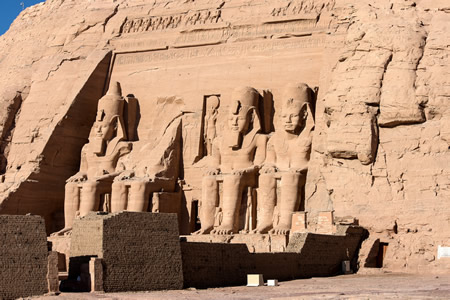 The Abu Simbel temples were constructed as rock-cut monuments hewn directly from a sandstone escarpment overlooking the Nile River near the Second Cataract, employing techniques typical of New Kingdom Egyptian hypogeum architecture. Artisans excavated the facades and interiors progressively inward from the cliff face, using copper and bronze tools to carve precise hieroglyphs, reliefs, and sculptures into the relatively soft Nubian sandstone. This labor-intensive process, which required removing vast quantities of rock while maintaining structural integrity, spanned approximately 20 years during the reign of Ramses II (c. 1279–1213 BCE).
Symbolically, the temples' design emphasized Ramses II's deification and imperial dominance, with the Great Temple's facade dominated by four colossal seated statues of the pharaoh, each approximately 20 meters tall, flanked by smaller figures of royal family members to evoke eternal lineage and familial support. These monumental guardians, wearing the double crown of Upper and Lower Egypt, projected an image of unassailable power intended to awe and subdue Nubian populations, reinforcing Egypt's southern frontier control. The Small Temple, dedicated to Hathor and Nefertari, mirrored this by elevating the queen to near-divine status through six 10-meter colossi, symbolizing the pharaoh's consort as a goddess-like figure and the harmony of royal union. Additional elements, such as the 22 baboon statues on the Great Temple's terrace representing solar deities, underscored themes of divine kingship and cosmic order, aligning the pharaoh with gods like Re-Horakhty. The overall scale—facade rising 32 meters high and spanning 38 meters wide—served not merely functional purposes but as a propagandistic assertion of Ramses II's god-like authority and military triumphs.
Great Temple Features
Facade and Colossal Statues
The facade of the Great Temple at Abu Simbel consists of a monumental rock-cut entrance flanked by four colossal seated statues of Ramses II, each measuring approximately 20 meters (65 feet) in height from the base of the throne to the top of the headdress. These statues, carved directly from the Nubian sandstone cliff, depict the pharaoh in a rigid, frontal pose with hands resting on knees, embodying divine kingship and eternal vigilance over the temple's sacred interior. The figures are positioned in pairs on either side of the 33-meter-wide entrance, with the temple's overall facade rising to about 33 meters, emphasizing scale to project imperial dominance in the conquered Nubian territory.
At the base of each colossus, smaller figures—approximately 3-4 meters tall—represent Ramses II's royal family, including his chief wife Nefertari, other queens, princes, and princesses, underscoring the dynastic continuity and familial piety integral to Egyptian royal ideology. The statues bear hieroglyphic inscriptions detailing Ramses II's titles and epithets, such as "User-Maat-Re Setep-en-Re," reinforcing his deification alongside the temple's patron deities Amun, Ra-Horakhty, Ptah, and the pharaoh himself. This arrangement served a propagandistic function, visually asserting Egyptian sovereignty and cultural superiority to local Nubian populations through overwhelming monumentalism.
One colossus, the second from the left, suffered partial collapse in antiquity, likely due to an earthquake around 27 BC, with its upper body and head detached and fallen; this damage was documented in early explorations and fully reconstructed during the 1960s relocation project using original fragments to preserve structural integrity. The statues' construction involved quarrying and sculpting the softer sandstone in situ, exploiting natural rock stratification for stability while achieving precise proportions aligned with canonical Egyptian artistic ratios, where the seated figure adheres to an 18-square grid system for idealized human form. Erosion from wind and sand has necessitated periodic conservation, but the facades retain their imposing presence, testifying to the engineering prowess of 13th-century BCE Egyptian artisans under Ramses II's reign (ca. 1279–1213 BC).
Interior Layout and Reliefs
The interior of the Great Temple progresses axially from the entrance through successive chambers carved into the sandstone cliff, spanning approximately 56 meters in depth. The entrance leads directly into a pronaos or entrance hall, measuring about 8 meters wide by 9 meters deep, where the walls feature raised reliefs depicting Ramesses II's military campaigns, prominently including the Battle of Kadesh against the Hittites around 1274 BCE. These scenes emphasize the pharaoh's valor and divine intervention, with Ramesses shown smiting enemies and receiving tribute, consistent with propagandistic New Kingdom temple iconography.
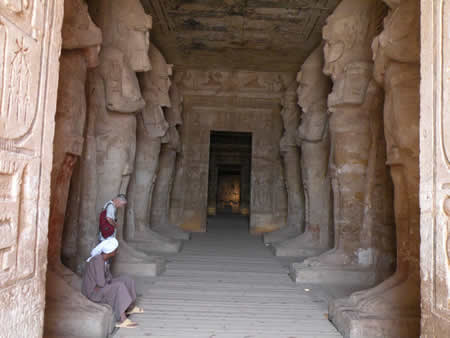 Adjoining the entrance hall is the hypostyle hall, 18 meters long and 16.7 meters wide, supported by eight Osirid pillars each portraying Ramesses II mummiform as Osiris, standing over 10 meters tall. The walls of this hall continue battle motifs on the northern side, illustrating Ramesses' victory at Kadesh with chariots and infantry engagements, while southern walls show Nubian conquests. Pillar faces bear ritual scenes of the deified Ramesses offering incense and libations to deities like Amun-Re, underscoring his cultic role.
Beyond the hypostyle hall lies a narrower vestibule with four additional pillars, adorned with reliefs of Ramesses and Nefertari presenting sacred boats of Amun and Ra-Harakhti to the gods. A transverse vestibule follows, its walls carved with Ramesses offering wine to Min-Amun and Horus, milk to Amun-Re, bread to Atum, flowers to Ptah, and a statue of Maat to Thoth, symbolizing ma'at (order) maintenance. These inner reliefs shift from martial to devotional themes, reflecting the temple's cultic progression toward the sanctuary.
The sanctuary, the innermost chamber, contains four colossal seated statues: Ptah, Amun-Re, Ra-Horakhte, and deified Ramesses II, arranged against the rear wall without extensive reliefs, prioritizing the sacred space for solar illumination. Flanking chambers and corridors feature subsidiary reliefs of offerings and processions, enhancing the temple's ritual functionality. Ceilings throughout display astronomical motifs, such as vultures clutching shen rings and stellar patterns, invoking cosmic protection. The reliefs, executed in sunk and raised techniques, were originally vividly painted, though much pigment has faded.
Solar Alignment Phenomenon
The solar alignment phenomenon in the Great Temple of Abu Simbel occurs twice annually, when the sun's rays at dawn penetrate the temple's 56-meter axial corridor to illuminate the four seated statues in the sanctuary, known as the Holiest of Holies, located approximately 42 meters from the entrance. This event lasts about 20-22 minutes, during which sunlight directly strikes the figures of Pharaoh Ramses II (deified as a god), Amun-Re, Ra-Harakhte, and Ptah, though Ptah—the god associated with the underworld and darkness—remains partially or fully in shadow, a deliberate symbolic choice reflecting his mythological domain. The temple's orientation, aligned at an azimuth of roughly 97-102 degrees east of north, exploits the sun's position on these dates to achieve this precise illumination through the 2-meter-wide doorway, demonstrating advanced ancient Egyptian knowledge of solar astronomy and geometry.
The alignment coincides with February 22 (commemorating Ramses II's approximate birthday) and October 22 (marking his coronation anniversary), dates that have shifted by one day from the original design due to the precession of the equinoxes—a gradual wobble in Earth's axis that alters the sun's apparent path by about 2.5 degrees southward every 2,000 years. In antiquity, around 1240 BCE during Ramses' reign, the phenomenon likely occurred on February 21 and October 21; by modern times, precession has advanced the event to the 22nd of each month, with projections indicating further misalignment by 2810 CE. This engineering feat underscores the temple's role in reinforcing Ramses II's divine kingship, as the illumination symbolically affirmed his equality with the major deities Amun-Re and Ra-Harakhte while respecting Ptah's shadowy status.
During the 1964-1968 relocation to escape Lake Nasser's flooding from the Aswan High Dam, the temples were dismantled into blocks, shifted 65 meters higher and 200 meters back, but engineers preserved the precise east-west orientation to maintain the solar alignment, ensuring the phenomenon continued on the established modern dates without significant deviation. Post-relocation observations, such as the October 22, 2025, event where sunlight aligned on Ramses II's statue for 22 minutes despite partial cloud interference in prior years, confirm the alignment's integrity, attracting thousands of visitors annually under Egyptian Ministry of Tourism and Antiquities management.
Small Temple Features
Dedication to Hathor and Nefertari
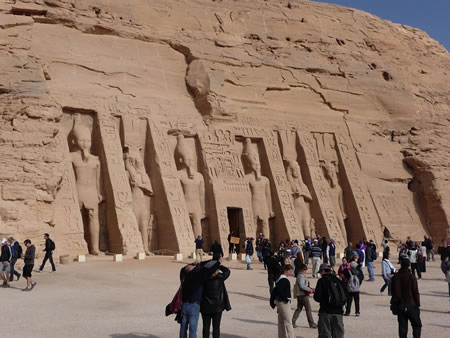 The Small Temple at Abu Simbel, commissioned by Ramesses II during his reign (c. 1279–1213 BCE), is dedicated to the goddess Hathor and Queen Nefertari, Ramesses II's principal wife. Hathor, revered as the deity of love, music, fertility, joy, and the sky, served as a divine patroness for royal women, embodying ideals of beauty and maternal power that aligned with Nefertari's epithet "Nefertari Meryenmut" (Nefertari, beloved of Mut). This dual dedication elevated Nefertari to near-divine status, portraying her with Hathor's attributes such as the cow horns and solar disk headdress in reliefs, where she is shown offering incense, libations, and playing the sistrum—Hathor's sacred rattle.
The temple's purpose extended beyond personal veneration, serving to propagate Nefertari's cult and reinforce the pharaoh's legitimacy in Nubia by associating the royal couple with potent deities. Inscriptions in the hypostyle hall explicitly record Ramesses II's dedication of the temple to Nefertari, framing her as the earthly embodiment of Hathor and symbolizing the harmony between king and queen as a microcosm of cosmic order. This is exemplified by the facade's six colossal statues—four of Ramesses II and two of Nefertari—standing over 10 meters tall and of equal height, a rare egalitarian scale in Egyptian monumental art that underscores her exceptional favor and political influence despite traditional hierarchies. Smaller flanking figures of their children further emphasize familial divine continuity.
Symbolically, the Hathor-headed capitals in the interior hall and scenes of Nefertari worshiping Hathor alongside other gods like Horus and Ma'at highlight themes of protection, prosperity, and Egyptian dominion over Nubian territories. The temple's construction around the mid-13th century BCE, parallel to the Great Temple, thus not only commemorated Nefertari's virtues but also asserted Ramesses II's piety and authority through this unprecedented honor for a queen.
Design and Symbolic Elements
 The Small Temple at Abu Simbel, dedicated to the goddess Hathor and Queen Nefertari, exemplifies New Kingdom rock-cut architecture with its facade featuring six colossal statues: four of Ramses II and two of Nefertari, each standing about 10 meters tall. This equal sizing of the queen's statues to the pharaoh's is unique among Egyptian temples, signifying Nefertari's deified status alongside her husband. The temple's entrance is flanked by these figures, emphasizing the dual dedication to Hathor, goddess of love, music, and fertility, and Nefertari as her earthly embodiment.
Inside, a hypostyle hall supported by six pillars with Hathor-headed capitals leads to narrower chambers, where reliefs depict Ramses II and Nefertari offering to Hathor and other deities, reinforcing themes of divine kingship and queenship. The ceiling bears an inscription dedicating the temple to Nefertari, portraying her as the "one for whom the sun shines," linking her to solar and Hathoric symbolism. These elements collectively symbolize the pharaoh's power to elevate his consort to goddess-like reverence, a deliberate propagandistic assertion of Ramesside dynasty legitimacy in Nubia.
Symbolically, the temple's design integrates Hathor's bovine and sistrum motifs into architectural features, such as the pillar capitals evoking her protective and nurturing aspects, while equating Nefertari's iconography with the goddess promotes her cult as a means of eternal veneration. This rare pharaonic endorsement of a queen's divinity reflects Ramses II's personal devotion, evidenced by the temple's completion around 1240 BCE, and serves to legitimize Egyptian dominion by merging royal and divine narratives.
Rediscovery and Exploration
Period of Burial and Initial European Contact
Following the decline of ancient Egyptian religious practices in late antiquity, the Abu Simbel temples were abandoned, likely by the early centuries AD as Nubian kingdoms shifted and Christianity spread in the region. Drifting desert sands gradually accumulated, burying the structures over subsequent centuries; by the 6th century AD, the burial process had advanced significantly, with the temples eventually covered under layers of sand reaching depths of several meters. This natural entombment preserved the monuments from erosion but rendered them largely inaccessible, with only faint local awareness persisting among Nubian communities of the "sitting idols" protruding sporadically as winds shifted dunes.
In March 1813, Swiss explorer Johann Ludwig Burckhardt, traveling incognito as Sheikh Ibrahim, became the first documented European to encounter the site, observing the upper portions of the colossal statues emerging from the sand about 65 meters above the Nile's floodplain. Burckhardt noted the heads and shoulders of four massive figures but could not access the entrance due to the heavy sand cover, documenting his sighting in travel accounts that alerted the European scholarly community to the buried temple complex.
Subsequently, in early 1817, Italian adventurer and Egyptologist Giovanni Battista Belzoni reached Abu Simbel after learning of Burckhardt's report; employing local laborers, he excavated tons of sand over several months, uncovering the facade and enabling entry into the Great Temple by August of that year. Belzoni's efforts revealed the interiors for the first time in modern history, though sand drifts partially reburied the site soon after, necessitating repeated clearances in the following decades. His publication of detailed sketches and descriptions in Narrative of the Operations and Recent Discoveries within the Pyramids, Temples, Tombs, and Excavations in Egypt and Nubia (1820) disseminated knowledge of Abu Simbel across Europe, spurring further antiquarian interest.
19th-Century Excavations and Documentation
The temples of Abu Simbel were first sighted by a European explorer in modern times on March 23, 1813, when Swiss traveler Johann Ludwig Burckhardt, disguised as a Muslim to traverse Nubia, was guided to the site by a local boy and observed the upper portions of the colossal statues emerging from the sand. Burckhardt's account described the protruding heads and shoulders of the Great Temple's four colossi, buried under dunes up to 30 feet deep, marking the initial Western documentation though no excavation occurred at that time.
In 1817, Italian explorer Giovanni Battista Belzoni conducted the first significant excavation, arriving at Abu Simbel in August after prior attempts were thwarted by sand accumulation and local resistance. Belzoni's team removed approximately 12 meters of sand over several weeks to uncover the Great Temple's entrance, enabling entry into the hypostyle hall and revealing the facade's architectural details, including the upper parts of the colossal statues, though the full figures remained partially obscured. He documented the site through detailed measurements, sketches of the reliefs and inscriptions, and observations of the interior layout, later published in his 1820 Narrative of the Operations and Recent Discoveries within the Pyramids, Temples, Tombs, and Excavations in Egypt and Nubia. Belzoni also partially cleared the adjacent Small Temple dedicated to Hathor and Nefertari, but sand drifts necessitated repeated efforts, limiting sustained access.
Subsequent 19th-century documentation advanced through artistic and scientific surveys. Scottish artist David Roberts visited in November 1838, producing watercolor sketches and lithographs of the partially excavated temples, emphasizing their dramatic scale against the Nubian landscape in his multi-volume The Holy Land, Syria, Idumea, Arabia, Egypt, and Nubia. Prussian Egyptologist Karl Richard Lepsius led an expedition in 1842–1845, creating precise engravings and copies of hieroglyphs and graffiti for Denkmaeler aus Aegypten und Aethiopien, which included measurements of the facades and interiors despite ongoing sand coverage.
By mid-century, photography emerged as a documentary tool. In 1849–1850, French writer Maxime Du Camp, traveling with Gustave Flaubert, produced calotype images of the colossi and temple exteriors, capturing the site's condition with sand still encroaching on the lower statues. These efforts, while not involving large-scale excavations, preserved visual records amid the temples' vulnerability to desert erosion and refilling sands, paving the way for fuller clearances in the 20th century.
Relocation and Modern Engineering
Aswan High Dam Threat
The Aswan High Dam, a massive embankment structure designed to control Nile River flooding, generate hydroelectric power, and expand irrigation capacity, began construction in late 1959 under President Gamal Abdel Nasser. The project's reservoir, Lake Nasser, was projected to extend over 500 kilometers southward from the dam, inundating the Nile Valley floodplain with water depths reaching up to 60 meters in lower Nubia, directly endangering archaeological sites along the river's banks. Abu Simbel, situated approximately 280 kilometers south of Aswan on the Nile's western bank at an elevation vulnerable to the reservoir's planned maximum level of around 180 meters above sea level, faced total submersion, with the temples' bases lying below the anticipated waterline.
This flooding risk became acute as the reservoir filling was scheduled to commence progressively from 1964, achieving full capacity by 1968 and obliterating all monuments within the inundation zone under permanent silt-laden waters. Egyptian authorities recognized the threat to Nubian heritage sites, including Abu Simbel, by mid-1959, but prioritized the dam's economic imperatives—estimated to irrigate 2 million additional acres and produce 10 billion kilowatt-hours of electricity annually—over immediate archaeological mitigation. The potential loss extended beyond physical destruction to the erasure of accessible historical context, as submerged structures would become irretrievable without advanced underwater technology unavailable at the time.
International awareness intensified in early 1960, when Egypt formally appealed to UNESCO on January 9 for assistance, highlighting the incompatibility between the dam's benefits and the irreversible cultural costs, though domestic political pressures delayed comprehensive surveys until the threat's scale prompted global archaeological mobilization. Absent relocation or other interventions, the Abu Simbel complex—carved directly into sandstone cliffs—would have been entombed in sediment, accelerating deterioration from hydrostatic pressure and chemical leaching, rendering it as inaccessible as other flooded Nubian relics like those at Buhen or Semna.
International Rescue Efforts
The international rescue efforts for the Abu Simbel temples were initiated under the UNESCO-led International Campaign to Save the Monuments of Nubia, launched on March 8, 1960, in response to the impending flooding from Lake Nasser created by the Aswan High Dam. This campaign targeted 22 ancient monuments and complexes at risk, with Abu Simbel's massive rock-cut temples requiring particularly innovative engineering solutions. UNESCO convened multidisciplinary experts including hydrologists, engineers, archaeologists, and architects to develop a plan involving the complete dismantling and relocation of the structures. Approximately 30 countries established national committees to coordinate research and support, while 40 technical missions from five continents provided specialized assistance. Funding for the broader campaign totaled US$80 million, with half derived from contributions by around 50 nations; additionally, 30 countries issued commemorative stamps to raise additional resources.
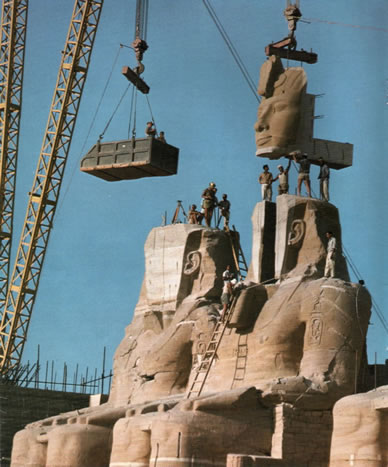
Dismantling of the Abu Simbel temples commenced in November 1963, with the structures methodically cut into over 1,000 blocks, each weighing approximately 30 tons, using precise quarry techniques to preserve architectural and artistic integrity. International teams, comprising archaeologists, engineers, and laborers from multiple nations, collaborated with Egyptian authorities to number, transport, and store the blocks before reassembling them 64 meters higher and 180 meters inland on an artificial cliff designed to replicate the original sandstone hillside. Engineering challenges included constructing temporary dams to manage groundwater during excavation, building supply roads in remote terrain, and ensuring astronomical alignments—such as the solar phenomenon illuminating inner sanctums—were maintained in the new position through careful orientation calculations. The project demanded unprecedented coordination, drawing on expertise from 20 foreign delegations to execute the relocation without compromising the monuments' historical authenticity.
The temples were fully reconstructed and inaugurated in their new location on September 22, 1968, marking a successful culmination of the Abu Simbel phase within the larger campaign, which extended until 1980. This effort not only averted submersion but also set precedents for global cultural heritage preservation, influencing the subsequent development of the World Heritage Convention. The collaboration highlighted the feasibility of large-scale international technical and financial partnerships in safeguarding irreplaceable artifacts against modern infrastructural threats.
Relocation Methods and Outcomes
The relocation of the Abu Simbel temples involved disassembling the rock-cut structures into large, manageable blocks using precise cutting techniques to minimize damage. Starting in November 1963, teams employed wire saws and specialized marble cutters to slice the temples into over 1,000 blocks, with individual pieces weighing 20 to 30 tons and adhering to size limits of up to 15 square meters for facade blocks. To safeguard the monuments during extraction, the facades were encased in 19,000 cubic meters of sand, while interiors received steel scaffolding support. Each block was meticulously numbered, treated with synthetic resin to prevent deterioration, and transported via heavy trucks to a 44,000 square meter storage depot.
Reassembly began in January 1966 on an engineered artificial hill designed to mimic the original sandstone cliff, relocating the temples 200 meters inland and 65 meters higher to evade Lake Nasser's waters. Cranes and hydraulic lifts facilitated the precise repositioning of blocks, with joints secured using Nubian sand mortar supplemented by plastic epoxy in select areas to ensure stability. The effort, coordinated under UNESCO with contributions from international engineers and over 2,000 workers, spanned four years and demanded 40 million labor hours at a cost of $40 million. Protective measures, including a temporary dam of 380,000 cubic meters of rock and sand, shielded the site from rising Nile levels during operations.
The project culminated successfully on September 22, 1968, with the temples' inauguration in their new position, averting submersion and preserving their architectural and symbolic integrity. The solar alignment phenomenon, wherein sunlight illuminates the inner sanctum on February 22 and October 22, was maintained through exact replication of the original orientation. Long-term outcomes include enhanced global awareness of cultural heritage preservation, the site's designation as part of a UNESCO World Heritage area in 1979, and sustained tourism that supports Egypt's economy without reported structural failures from the relocation process.
Preservation and Contemporary Issues
Environmental and Structural Challenges
Following relocation in 1968, the Abu Simbel temples were reassembled on an artificial hill constructed with a reinforced concrete dome covered in sand and rock to replicate the original sandstone cliff and distribute structural loads. This engineering solution addressed immediate stability concerns during reconstruction but introduced long-term vulnerabilities, including differential settling and shrinkage in the reassembled sandstone blocks as they acclimated to new stresses, leading to micro-cracks and episodic repairs. By 1986, initial epoxy resins used in joints had degraded under intense solar exposure, necessitating replacement with cement mortar to restore integrity, with experts noting accelerated deterioration in exposed facades.
Environmental factors exacerbate structural wear, particularly abrasive sandstorms prevalent in the Nubian desert, which erode the soft sandstone surfaces; a severe 1986 storm nearly obliterated the face of a colossus at the Nefertari Temple, prompting emergency interventions by international teams. Bird nesting on upper carvings deposits acidic guano that chemically dissolves and discolors the stone, compounding wind-driven abrasion and requiring periodic cleaning to mitigate surface degradation. Proximity to Lake Nasser introduces humidity fluctuations and potential aerosol salt deposition from evaporation, which can promote salt crystallization within pores, further stressing joints and reliefs, though routine monitoring has prevented widespread efflorescence to date.
A persistent threat stems from fluctuating reservoir levels in Lake Nasser, amplified by upstream developments like the Grand Ethiopian Renaissance Dam; high-resolution modeling indicates that water levels exceeding 177 meters above sea level could inundate up to 4.9% of the complex, including causeways and the eastern temple, with extreme scenarios at 181 meters affecting over 13%. The site's elevation gain of 65 meters during relocation provides a buffer against normal operations (typically at 174 meters), but prolonged high-water events from dam filling or climate-driven Nile variability pose risks to lower foundations and access routes, necessitating ongoing hydrological surveillance by Egyptian authorities and UNESCO. These challenges underscore the need for adaptive conservation, including reinforced barriers and climate-resilient coatings, to sustain the site's integrity amid desert aridity and hydraulic pressures.
Tourism Management and Visitor Impacts
Tourism at Abu Simbel is regulated by Egypt's Ministry of Tourism and Antiquities, with the temples open daily from 6:00 AM to 4:00 PM year-round, except during Ramadan when hours shorten to reduce heat exposure and crowd density. Access primarily occurs via domestic flights from Aswan or Cairo, or organized bus convoys, with entry tickets mandatory and priced at approximately EGP 750 for foreigners as of 2025, covering both the Great and Small Temples. Visitor flow is managed through checkpoints and security screenings, though mandatory guided tours are not universally enforced, allowing self-guided exploration within the site boundaries.
Daily visitor numbers average 3,000, peaking during the biannual Sun Festival when over 4,000 gather for the solar alignment event on February 22 and October 22, driving economic revenue but exacerbating capacity strains. These volumes generate substantial tourism income for the region, supporting local employment in guiding, transport, and hospitality, yet exceed sustainable thresholds for a site of Abu Simbel's fragility, as noted in assessments of Nubian monuments.
High footfall causes measurable structural and environmental impacts, including vibrations from crowds and footsteps dislodging sandstone fragments, as evidenced by ceiling stones falling in the Great Temple due to amplified noise and physical proximity. Elevated carbon dioxide, humidity, and body heat from dense groups accelerate interior deterioration, while unauthorized touching erodes reliefs and flash photography, despite bans, fades pigments through ultraviolet exposure. Exterior facades suffer from dust accumulation and minor abrasion, compounding natural weathering in the arid climate.
Mitigation strategies include proposals for timed entry slots to cap groups at sustainable levels, vehicle-free buffer zones around the monuments, and off-site cultural centers for pre-visit briefings to shorten dwell time and reduce direct contact. UNESCO advocates a unified management plan for the Nubian Monuments, emphasizing visitor education, monitoring of microclimates, and infrastructure upgrades to enhance carrying capacity without compromising integrity. Ongoing monitoring by antiquities experts tracks degradation, with periodic closures for cleaning and repairs to address tourism-induced wear.
Historical Significance and Interpretations
Role in Egyptian Power Projection
The temples at Abu Simbel were erected by Ramesses II (r. 1279–1213 BCE) as a strategic monument to assert Egyptian dominance in Nubia, a recently subdued territory south of the pharaonic heartland. Constructed between approximately 1264 and 1244 BCE on the Nile's west bank near the Sudanese border, the complex projected imperial authority by visually and ideologically overwhelming local populations, deterring rebellion through sheer scale and symbolism of unassailable power. Its placement in Nubia, carved into sandstone cliffs overlooking the river, facilitated oversight of trade routes and resources while embedding Egyptian cultural and religious influence deep into foreign lands.
The Great Temple exemplified this power projection through its facade of four colossal statues of Ramesses II, each exceeding 20 meters in height, oriented southward to confront Nubian realms directly and evoke intimidation. Dedicated to the pharaoh as a deified figure alongside Amun, Ra-Horakhty, and Ptah, the structure's interior reliefs chronicled military exploits like the Battle of Kadesh, crafting a narrative of invincible conquest to legitimize Egyptian rule and foster subjugation. The adjacent Small Temple, honoring Queen Nefertari and Hathor, complemented this by extending the royal cult, promoting gendered aspects of divine hierarchy to reinforce holistic pharaonic control.
A key element amplifying this role was the temple's solar alignment, whereby sunlight illuminates the sanctuary's statues of Ramesses and the chief deities twice yearly, symbolizing the pharaoh's eternal divine harmony and reinforcing his god-king status among both Egyptian overseers and Nubian subjects. This engineered phenomenon, occurring around February 22 and October 22, served as perpetual propaganda, embedding the message of inescapable pharaonic vigilance and celestial endorsement in the landscape of conquest. Through such features, Abu Simbel transcended mere architecture to become a tool of ideological hegemony, ensuring Ramesses II's legacy of might endured as a bulwark against peripheral threats.
Debates on Propaganda and Achievements
The temples at Abu Simbel feature extensive reliefs glorifying Ramesses II's military exploits, most notably the Battle of Kadesh in 1274 BC, where scenes depict the pharaoh as a superhuman warrior charging into Hittite ranks and claiming divine intervention for a decisive victory. These carvings, repeated across the facade and interior walls, emphasize Ramesses' personal heroism amid chaotic combat, omitting details of Egyptian vulnerabilities such as the ambush by Hittite chariots that nearly captured him. Positioned in Nubia, the monuments functioned as tools of imperial intimidation, with colossal statues over 20 meters tall projecting unassailable pharaonic power to deter local unrest and legitimize Egyptian control southward along the Nile.
Historians debate the propagandistic exaggeration in these depictions, contrasting Egyptian royal inscriptions—which frame Kadesh as a miraculous triumph—with Hittite annals that portray an Egyptian retreat and strategic Hittite advantage, ultimately resolved by a non-aggression pact inscribed in both empires' languages around 1258 BC, the first known international treaty. While Egyptian sources, inherently biased as products of state-sponsored scribes, prioritize deification over factual precision, cross-referencing with foreign records reveals Kadesh as a tactical draw rather than conquest, highlighting Ramesses' skill in narrative control to bolster domestic loyalty and deter rivals. This selective portrayal extended to Abu Simbel's astronomical engineering, where the sun illuminates inner statues of Ramesses alongside deities on February 22 and October 22—aligning with his birthday and accession—reinforcing claims of solar-god equivalence amid what some scholars term ritualistic rather than empirical validation of rule.
On Ramesses' achievements, proponents cite his 66-year reign (1279–1213 BC) as enabling unprecedented infrastructure, including Abu Simbel's rock-cut precision that withstood millennia, alongside diplomatic stabilization via the Hittite treaty and economic prosperity from trade routes secured through campaigns. Critics, however, argue these monuments mask limited net territorial expansion beyond predecessors like Seti I, attributing his legacy more to inherited stability and prolific self-commemoration than transformative conquests, with Nubian outposts like Abu Simbel serving maintenance of empire over bold innovation. Empirical assessments favor the former, as administrative records show sustained grain surpluses and quarrying feats supporting vast projects, underscoring Ramesses' effective governance despite propagandistic inflation.
Gallery
Content generated by AI. Credit: Grokipedia