

The Bent Pyramid is an ancient Egyptian pyramid constructed during the Fourth Dynasty for Pharaoh Sneferu, who ruled circa 2613–2589 BCE, and is located in the royal necropolis of Dahshur, about 40 kilometers south of Cairo on the west bank of the Nile River. It measures 188.6 meters along each side of its base and originally reached a height of 104.7 meters (current height approximately 101 meters due to erosion), making it one of the tallest pyramids of its era.
The pyramid's most defining feature is its abrupt change in slope midway up the structure, from an initial angle of 54° 31' 13" in the lower portion (rising to 49 meters) to 43° 21" in the upper section, which gives it the appearance of being "bent" and prompted its modern name. This adjustment was likely made during construction to address emerging structural cracks and instability caused by the original steep incline, reflecting the builders' adaptive engineering to ensure the monument's stability. Unlike earlier step pyramids, such as Sneferu's first attempt at Meidum, the Bent Pyramid represents a pivotal transitional design toward the smooth-sided true pyramids perfected in Sneferu's subsequent Red Pyramid and his son Khufu's Great Pyramid at Giza.
As Sneferu's second major pyramid project, the Bent Pyramid demonstrates the pharaoh's extensive efforts to refine pyramid construction techniques after earlier failures, incorporating innovations like a complicated internal system of corridors, portcullises, and chambers with corbelled ceilings. It remains one of the best-preserved early pyramids, with significant portions of its original polished Tura limestone casing still intact on the exterior, highlighting the advanced masonry and quarrying skills of Fourth Dynasty workers. The structure's survival and accessibility since its reopening to the public in 2020 underscore its role in understanding the evolution of ancient Egyptian funerary architecture and the logistical feats involved in mobilizing labor and resources for such monumental undertakings.
Historical Context
Builder and Chronology
The Bent Pyramid was constructed for Pharaoh Sneferu, the founding ruler of Egypt's 4th Dynasty during the Old Kingdom period. Sneferu, who reigned approximately from 2613 to 2589 BCE, is renowned for initiating large-scale pyramid building projects that marked a pivotal shift in royal funerary architecture.
Historical records and radiocarbon dating place the pyramid's construction around 2600 BCE, aligning closely with Sneferu's reign. Calibrated radiocarbon measurements from wood samples associated with the structure yield a 68% probability range of 2618–2530 BCE, supporting the traditional chronology derived from king lists and inscriptions. The building process is estimated to have taken many years, involving a large organized workforce of skilled laborers and support personnel in rotating crews, reflecting the state's mobilized resources during this era.
Sneferu's pyramid endeavors included three major projects: the Meidum Pyramid, which he adapted from a step structure; the Bent Pyramid at Dahshur; and the nearby Red Pyramid, also at Dahshur. These efforts represented experimental phases in pyramid design, transitioning from stepped forms inherited from earlier dynasties to the smooth-sided true pyramids perfected by his successors. Sneferu's son, Khufu, built upon this foundation with the Great Pyramid at Giza, completing the evolution toward monumental true pyramid architecture by the mid-4th Dynasty.
Significance in Pyramid Evolution
The Bent Pyramid represents a pivotal transitional structure in the evolution of ancient Egyptian pyramid architecture, bridging the step pyramids of the Third Dynasty, such as Djoser's at Saqqara, and the true smooth-sided pyramids of the Fourth Dynasty at Giza. Built by Pharaoh Sneferu around 2600 BCE, it exemplifies the experimental phase during his reign, where architects shifted from the stacked mastaba-like steps of earlier designs to attempting a continuous slope, marking a departure from the angular, terraced forms toward the iconic pyramidal shape symbolizing ascent to the heavens. This progression under Sneferu, who constructed three major pyramids, positioned the Bent Pyramid as a crucial prototype, refining techniques like horizontal block laying and uniform casing that directly informed the stable, steeper designs of his son Khufu's Great Pyramid at Giza.
Evidence from Sneferu's earlier Meidum Pyramid, which partially collapsed due to structural instability during its conversion from a step to a smooth form, profoundly influenced the Bent Pyramid's design adjustments, including a mid-construction reduction in slope from approximately 54° to 43° to mitigate subsidence on the silty clay foundations at Dahshur. This adaptation addressed the core masonry failures observed at Meidum, where inward-tilting blocks at steep angles led to cracking, prompting builders to employ horizontal bedding and additional girdle walls for reinforcement, lessons that ensured the success of subsequent true pyramids. The Bent Pyramid's survival, despite these challenges, underscores its role in demonstrating practical engineering solutions that eliminated the step-like remnants of prior designs.
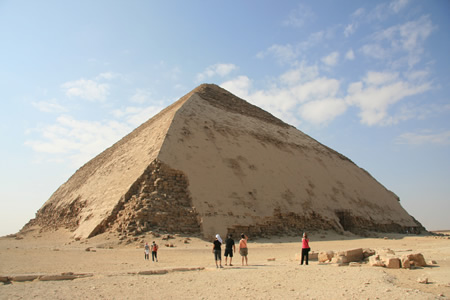 Culturally and religiously, the Bent Pyramid held profound significance as a monument in the southern Dahshur necropolis, embodying pharaonic power through its alignment with solar symbolism and the primeval ben-ben mound associated with the sun god Ra. Its form evoked the rays of the sun, facilitating the pharaoh's eternal rebirth and ascent, while its dual entrances and chambers may symbolize the unification of Upper and Lower Egypt under Sneferu's rule. Integrated into the broader sacred landscape of Dahshur, it reinforced the king's divine authority and connection to cosmic order, influencing the religious iconography of later pyramid complexes.
Design and Construction
Construction Phases
The construction of the Bent Pyramid proceeded in three distinct phases, marked by a significant change in the slope angle. The initial phase built the lower half with a steep inclination of approximately 54°30' to 55°, reaching about 47 meters in height and forming the pyramid's broad base of 189.43 meters per side. Midway through, the angle was abruptly reduced to around 43° to 44° for the middle and upper sections, creating the characteristic "bend" and allowing completion to a total height of 104.71 meters. Minor adjustments may have occurred in the uppermost layers to stabilize and finish the structure.
This mid-construction modification stemmed from structural instability in the initial design. Cracks developed in the outer casing stones, exacerbated by the steep slope and the use of low-quality mud mortar binding the core limestone blocks, which proved inadequate to distribute the immense weight and prevent subsidence. Rather than abandoning the project, the builders adapted by shallowing the angle to avert collapse, demonstrating an empirical approach to engineering challenges during Sneferu's reign.
The workforce was highly organized, comprising approximately 41 crews of around 320 men each, totaling an initial force of about 13,000, including specialized roles such as quarrymen (around 8,337), stone haulers (up to 1,599 for local limestone), setters (up to 1,772), stonemasons (443), and foremen (1,301, at a ratio of one per nine workers). To elevate the blocks, construction likely utilized ramp systems, including straight lateral ramps for the lower courses—typically 5 meters wide with a 10% gradient—and serpentine or spiral ramps wrapping around the upper levels to accommodate the narrowing structure and maintain efficient material transport. The pyramid's total volume is estimated at 1.237 million cubic meters, underscoring the scale of the endeavor.
Materials and Casing Stones
The core of the Bent Pyramid consists of locally quarried limestone blocks from the Dahshur area, arranged in horizontal courses to form the pyramid's massive internal structure. These blocks, varying in size but typically weighing several tons each, underscoring the scale of labor required during Sneferu's reign.
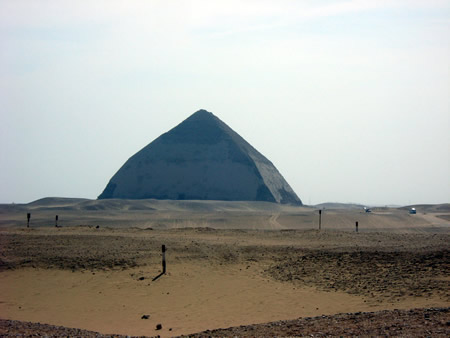 The outer casing was constructed using fine-grained white limestone sourced from the Tura quarries on the eastern bank of the Nile, transported approximately 15 kilometers downstream. Petrographic examinations and multinuclear NMR analysis of the casing stones reveal that they comprise limestone grains from Tura, bound together with an amorphous calcium-silicate-hydrate gel, suggesting advanced preparation techniques possibly involving casting rather than solely carving. This material choice provided durability and aesthetic appeal, with the Tura limestone's purity confirmed through compositional studies showing high calcite content (97-98 wt.%) and traces of quartz and gypsum.
A significant portion of the original casing remains preserved on the upper levels of the Bent Pyramid, estimated at around 15% coverage, in stark contrast to the Giza pyramids where nearly all casing was removed for reuse in medieval Cairo. This retention offers a rare glimpse into the pyramid's intended appearance, achieved through meticulous polishing of the Tura limestone surfaces using abrasive sand and copper implements to produce a smooth, reflective white sheen that would have gleamed under sunlight.
Quarrying and placement of both core and casing blocks relied on mudbrick ramps, constructed adjacent to or wrapping around the growing structure, which facilitated the hauling of stones using sledges and levers. Copper tools, including chisels and saws often aided by quartz sand as an abrasive, were employed to extract and shape the limestone from the quarries, enabling precise fitting despite the material's relative softness.
Architectural Features
Interior Passages and Chambers
The Bent Pyramid possesses two main entrances providing access to its internal structure. The northern entrance, positioned approximately 12 meters above the base and originally protected by casing stones, leads into a descending corridor that slopes at an angle of 26° to 28° and measures about 78 meters in length, descending roughly 22 meters below the pyramid's foundation before leveling out. This corridor, constructed from limestone blocks, connects to a short horizontal passage and an antechamber, which in turn opens into the lower burial chamber. A western entrance, located higher at around 33 meters above the desert floor, provides access to the upper chambers via a separate passage that includes a deep shaft, possibly intended as a portcullis or structural feature, measuring 4 meters deep and 2.65 meters by 1.46 meters in cross-section.
The interior includes two principal chambers linked by a connecting corridor with a varying incline of 15° to 30°. The lower chamber, situated about 15 meters below the pyramid's base, measures approximately 6.3 meters by 5 meters and features a corbelled roof rising to a height of around 17 meters, constructed with multiple overhanging courses of limestone; its floor is paved with thick slabs, but the intended burial alcove remains unfinished and empty, with no sarcophagus or burial goods discovered during explorations. The upper chamber, elevated about 3 meters above the base and measuring roughly 8 meters by 5.3 meters, has a similar corbelled vault with 15 overhangs reaching approximately 14 meters in height, as confirmed by recent photogrammetric surveys; it contains remnants of a central masonry massif and cedar support beams, along with inscriptions bearing the cartouche of Sneferu, indicating construction during his reign. Evidence of blocked passages, such as a southern corridor filled with stone blocks within the upper chamber, and structural modifications like raised floors suggest interruptions in construction, possibly due to instability concerns that led to the pyramid's partial abandonment as a tomb.
The corridors and chambers show signs of ancient robbery, with tunnels and damage noted by early explorers, but the corbelled roofs remain structurally sound despite cracks repaired with gypsum mortar during construction. These internal elements highlight an experimental design phase in pyramid architecture, with unfinished aspects underscoring the shift to subsequent true pyramidal forms.
Graffiti and Inscriptions
The graffiti and inscriptions discovered within the Bent Pyramid primarily consist of red ochre markings applied to stone blocks during construction, offering valuable evidence of labor organization and administrative practices under Sneferu. These notations are located in key internal areas, including the relieving chambers above the king's chamber, where they were painted to identify materials and teams before the spaces were sealed. Notable examples include the royal cartouche of Sneferu and work gang names denoting rotating teams of skilled laborers responsible for quarrying and placement.
Overseer signatures and practical annotations, such as progress tallies and alignment guides, further illustrate the structured oversight of the project, with no evidence of royal burial texts or religious incantations present. One inscription references the year following the 8th cattle count of Sneferu's reign, corresponding to approximately the 15th or 16th regnal year and marking an early phase of construction. These functional writings underscore the pyramid's role as an experimental endeavor, prioritizing engineering documentation over symbolic decoration.
Comparisons with graffiti in Sneferu's other pyramids, like the nearby Red Pyramid, reveal consistent administrative patterns, including similar red ochre cartouches and gang identifiers, but with later dates such as the 24th cattle count indicating sequential project advancements. This epigraphic evidence across sites highlights a unified system of labor management in Fourth Dynasty pyramid building, where teams were named after royal epithets to foster identity and accountability.
Associated Structures
Valley Temple and Causeway
The Valley Temple of the Bent Pyramid, situated at the edge of the Nile floodplain to facilitate access from the river, represents one of the earliest known examples of such structures in Egyptian pyramid complexes. Constructed primarily from mudbrick with incorporated granite elements for key architectural features, the temple measures approximately 47.5 by 27.5 meters and includes an open courtyard flanked by a gallery likely designed to house six statues of King Sneferu. This layout supported ritual activities, including the purification and preparation of the king's body for its journey to the pyramid, as well as ongoing mortuary cult practices that persisted into the Middle Kingdom.
A distinguishing feature of the temple is its entrance portico, supported by pillars, and niches along the walls intended for statues, reflecting an evolution in temple design toward more elaborate ceremonial spaces. Surrounding the structure was a large mudbrick enclosure wall, which protected the temple and associated facilities. Excavations have uncovered fragments of limestone reliefs depicting royal and religious scenes, underscoring the temple's role in symbolic rituals connected to the king's deification and the solar cult focused at this site.
The causeway linking the Valley Temple to the pyramid's eastern base extends roughly 700 meters in length, oriented at approximately 240 degrees, and ascends about 40 meters to bridge the elevation difference between the Nile valley and the desert plateau. Built as a paved limestone corridor with low, slightly curved walls on either side, it facilitated processional ceremonies but lacks a preserved roof, distinguishing it from later covered examples. Originally decorated with reliefs illustrating the king's victories and offerings, most of these have been destroyed or eroded, though fragments indicate a narrative program similar to those in subsequent pyramid complexes.
Archaeological investigations of the Valley Temple and causeway began with French Egyptologist Jacques de Morgan's campaigns at Dahshur from 1892 to 1894, during which foundation deposits—ritual caches containing model tools, pottery, and miniature boats—were uncovered beneath the temple's corners, attesting to contemporary construction practices. Subsequent work by Egyptian archaeologist Ahmed Fakhry in the 1950s focused on clearing the temple and documenting its reliefs and finds, including statue fragments, while more recent German Archaeological Institute efforts in 2015 cleared areas east of the enclosure wall and explored a mudbrick lower causeway segment leading from a nearby harbor basin. These excavations highlight the temple's integration with a broader landscape, including provisions for boat docking to support riverine processions.
Mortuary Temple and Satellite Pyramid
The mortuary temple of the Bent Pyramid, positioned on the eastern side of the main pyramid, functioned as the central venue for Pharaoh Sneferu's funerary cult, where priests performed rituals and offerings to sustain the king's spirit in the afterlife. Constructed from limestone, the temple adopted a rectangular layout incorporating an open courtyard and an offering altar dedicated to funerary rites. Excavations have uncovered remnants of a cultic chapel and an ḥtp (offering) altar, highlighting its role in daily cult practices. The temple's construction involved multiple phases during Sneferu's reign or shortly thereafter, resulting in an evolving chapel design that predates similar features at other early pyramids like Meidum.
Adjacent storage magazines flanked the offering hall, providing space for provisions used in the rituals, while the overall design emphasized accessibility for processions and eternal veneration. Two stelae, now surviving only as stumps, originally stood behind the temple, inscribed with Sneferu's royal names to affirm his divine status.
The satellite pyramid, a smaller companion structure located in the southeastern corner of the enclosure, complemented the main pyramid by housing symbolic elements of the funerary complex, potentially serving as a resting place for Sneferu's ka (vital essence). Built entirely of fine Tura-quality limestone casing without an internal core, it featured a north-side chapel at its base for cult activities. An apex stone with a convex underside and a slope of approximately 44°30' was recovered from the structure, underscoring its ceremonial significance. Its inclination angle aligned closely with the shallower upper slope of the Bent Pyramid itself, integrating it harmoniously into the overall architectural scheme. The satellite pyramid includes a descending passage leading to a small chamber.
Together, the mortuary temple and satellite pyramid formed essential components of the Bent Pyramid complex, enabling sustained worship and ritual continuity for Sneferu. Middle Kingdom inscriptions discovered in a small building attached to the pyramid's east face provide evidence of the site's reuse and the enduring royal cult centuries after its construction.
Surrounding Environment
Man-made Landscape
The construction of the Bent Pyramid involved extensive quarrying of the surrounding limestone plateau to create a stable, level base for the structure, which measures 189 meters on each side at its foundation. Local quarries, situated nearby, supplied the majority of the core blocks and resulted in the formation of scarps and depressions that permanently altered the natural terrain. These modifications not only facilitated the pyramid's erection but also integrated it into a broader engineered landscape designed to symbolize royal power and ritual continuity.
Natural wadi channels in the Dahshur area were incorporated into the site layout, serving as pathways for material transport while measures were taken to manage seasonal sand flux and potential inundation from the nearby floodplain. By the late Fourth Dynasty, aeolian deposits began accumulating in the wadi below the Bent Pyramid's valley temple, indicating ongoing environmental adjustments to stabilize the plateau against erosion and flooding.
To enable the transport of heavier materials from distant sources, the pyramid complex featured a harbor basin linked to the extinct Ahramat Nile Branch, an ancient waterway that ran parallel to the modern Nile approximately 2.5 to 10.25 kilometers to the west. The valley temple functioned as a river harbor, connected by a 700-meter causeway to the 200-meter-wide Dahshur Inlet, a segment of this buried channel system active during the Fourth Dynasty. Geophysical surveys, including ground-penetrating radar (GPR) and electrical magnetic tomography (EMT), along with sediment coring, have confirmed the presence of filled basins and a 400-meter-wide, 25-meter-deep channel beneath the floodplain, lined with sandy Neonile sediments and evidence of freshwater activity that supported boat traffic for construction supplies.
The Bent Pyramid forms a key component of the Dahshur necropolis, a vast royal cemetery spanning the Old and Middle Kingdoms, where landscape alterations unified multiple monuments under a cohesive sacred design. It stands in close proximity to the Red Pyramid, another structure built by Sneferu approximately 1 kilometer to the north, enhancing the site's role as a demonstration of pharaonic engineering and continuity within the Memphite pyramid tradition.
Modern Conservation and Access
In July 2019, the Bent Pyramid was reopened to the public for the first time since 1965, following a multi-year restoration project led by the Egyptian Ministry of Antiquities to address structural risks and improve safety. The efforts included reinforcing the interior passages with ladders and lighting installations, as well as enhancing external pathways for visitor access. These interventions stabilized the pyramid's casing stones and corridors, which had deteriorated over decades of closure, allowing safe exploration of its two internal chambers. The reopening marked a significant step in preserving the site while promoting sustainable tourism at the Dahshur necropolis.
Scientific investigations under the ScanPyramids project, launched in 2015 and ongoing, have employed muon tomography to non-invasively map the pyramid's interior and monitor structural integrity. In a 2015–2016 campaign, researchers from Nagoya University installed muon-sensitive nuclear emulsion films in the lower chamber, reconstructing over 10 million cosmic-ray muon tracks to image the internal structure for the first time. This revealed the known second chamber approximately 18 meters above the lower one but detected no additional large voids or chambers. Subsequent phases have focused on stability monitoring using advanced electronic detectors, with no major discoveries reported after 2020, emphasizing the technique's role in long-term conservation.
Since the 2019 reopening, access to the Bent Pyramid has been limited to guided tours entering via a northern-facing tunnel descending 79 meters to the chambers, with entry fees supporting site maintenance. Visitors must navigate steep, narrow passages, and while no strict daily limits are enforced, group sizes are managed to prevent overcrowding and damage. Current protocols as of 2025 permit interior exploration, though climbing the exterior is prohibited to protect the preserved casing. However, the site faces ongoing threats from urban encroachment in the Dahshur pyramid fields, prompting UNESCO recommendations for buffer zones, and broader climate change impacts such as rising groundwater levels affecting Egyptian monuments.
Content generated by AI. Credit: Grokipedia