

Abu Gorab is an archaeological site in ancient Egypt, located approximately 15 kilometers south of Cairo on the west bank of the Nile, between Saqqara and Giza and about 1 kilometer north of Abusir, renowned for its Fifth Dynasty (c. 2465–2323 BCE) sun temples dedicated to the sun god Ra.
These open-air sanctuaries, constructed during the Old Kingdom around 2500 BCE, represent a rare architectural form emphasizing solar worship and the pharaoh's divine connection to Ra, with only a few examples surviving from an original series of at least six planned temples. The site features the sun temples of Pharaohs Userkaf and Nyuserre Ini, with Nyuserre's (r. c. 2445–2421 BCE) being the most prominent and best preserved, including a massive obelisk over 40 meters tall symbolizing the sun's rays, expansive courtyards, alabaster altars for offerings, smaller obelisks, and a sanctuary once adorned with a statue of Ra, all aligned with the summer solstice sunrise to reflect Egyptian cosmology.
Archaeological excavations, beginning in the early 20th century and continuing with recent efforts, have uncovered significant artifacts including wall murals depicting fowling scenes from c. 2430 BCE, stone basins, pottery fragments, and clay seals bearing royal names, providing insights into Old Kingdom religious rituals and royal succession.
In 2021, a joint Egyptian-Polish team led by Dr. Massimiliano Nuzzolo discovered the mud-brick foundations of a previously lost third sun temple beneath Nyuserre's structure, complete with a 61 cm deep white limestone pillar base, beer jars used for offerings, and an east-west oriented courtyard, marking one of the most important finds in Egyptian archaeology in over 50 years. Further work in 2022 by an Italian-Polish mission revealed even older remains, accessed via a limestone doorway and mud-brick shaft lined with quartz slabs, along with seals possibly linked to Pharaoh Shepseskare, suggesting Abu Gorab may hold the area's earliest Fifth Dynasty structures and deepening understanding of the era's pharaonic cult.
Location and Overview
Geographical Setting
Abu Gorab is situated on the western bank of the Nile River within the Memphite necropolis of ancient Egypt, approximately 1 kilometer north of the Abusir pyramid complex and about 15 kilometers south of the Giza pyramid plateau. The site forms part of the broader UNESCO World Heritage-listed pyramid fields from Giza to Dahshur, extending southward through Zawyet el-Aryan, Abusir, and Saqqara.
The locality occupies a desert plateau rising above the Nile floodplain, characterized by exposed limestone bedrock from the Late Eocene Maadi Formation, which provided readily available quarrying resources for monumental construction. This elevated position, at around 30 meters above sea level, offered unobstructed views toward the east and facilitated the transport of building materials via proximity to an ancient Nile branch that once bordered the necropolis.
In relation to nearby archaeological sites, Abu Gorab lies immediately adjacent to the Fifth Dynasty pyramids of Abusir and approximately 10 kilometers north of the extensive Saqqara necropolis, integrating it into the central Memphite burial landscape. Today, the site is accessible via the Cairo-Alexandria Desert Road, located about 25 kilometers southwest of central Cairo.
Historical Significance
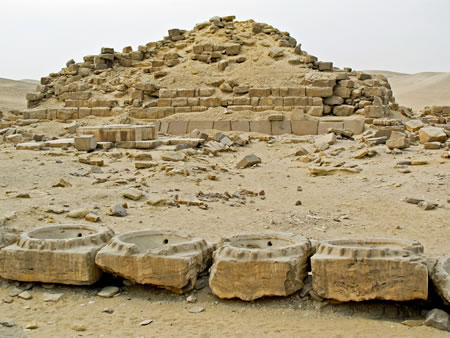 Abu Gorab's occupation spans from the Early Dynastic Period, beginning with the 1st Dynasty around 3100 BCE, when it served as a burial ground for middle-ranking officials, through the Old Kingdom, with its peak activity during the 5th Dynasty circa 2445–2421 BCE under pharaohs like Niuserre, after which the site saw no significant later development.
The site's cultural evolution reflects a profound shift in ancient Egyptian religious practices, transforming from a cemetery for middle-ranking officials in the Early Dynastic era to a central hub for sun worship by the 5th Dynasty, when pharaohs constructed dedicated solar temples to honor the god Ra, underscoring the growing prominence of solar theology in state religion. This transition paralleled the dynasty's emphasis on Ra as a creator deity and symbol of royal power, integrating funerary traditions with cosmic renewal rituals performed at the temples.
As an integral component of the Memphite necropolis, Abu Gorab connected to the broader pyramid-building landscape of the Old Kingdom, facilitating the pharaohs' alignment of mortuary complexes with Heliopolis, the ancient center of sun worship. Its significance lies in illuminating the development of solar theology, where structures like the monumental obelisk at Niuserre's temple represented the benben stone and rays of Ra, influencing later Egyptian architectural forms such as standalone obelisks.
Early Dynastic Remains
Cemetery Layout
The Early Dynastic cemetery at Abu Gorab, known as Bonnet's Cemetery after the scholar Hans Bonnet who first documented it, is situated on the desert plateau east of the Lake of Abusir, forming part of the broader Memphite necropolis. This burial ground consists of a cluster of approximately 78 tombs, including 70 shaft tombs, three simple grave pits, four stairway tombs, and one recessed brick chamber tomb, arranged in informal groups rather than strict formal rows, though the overall distribution spans a compact area integrated into the larger 2 km² archaeological concession of Abusir South. The tombs are oriented primarily with burials facing south or southeast, reflecting typical Early Dynastic alignment practices, and occupy a position on the elevated desert edge overlooking the ancient floodplain, facilitating ritual access from the Nile Valley.
Architecturally, the superstructures of these tombs are constructed primarily from mudbrick, with some featuring limestone facings or reinforcements to enhance durability against the desert environment, embodying the transitional designs of the First and Second Dynasties. Underground components include deep burial shafts leading to chambers equipped with niches for offerings and storage, alongside small serdab chapels—sealed rooms for statues of the deceased—characteristic of First Dynasty elite tomb architecture that emphasized perpetual cultic provisions. Stairway tombs, in particular, incorporate descending passages to substructures, allowing for ritual processions, while the overall modest scale distinguishes them from contemporary royal complexes at Saqqara.
The cemetery served as a burial site for middle- to high-ranking non-royal officials, such as scribes and administrators affiliated with the Memphis region, underscoring the site's role in accommodating the emerging bureaucratic elite during the unification of Egypt under the First Dynasty. Grave goods and tomb inscriptions, where preserved, indicate these individuals held administrative roles supporting the central authority, rather than royal lineage, highlighting the cemetery's function within a hierarchical Memphite funerary landscape that prioritized proximity to the capital for status display.
Key Burials and Artifacts
One of the most significant discoveries in the Early Dynastic cemetery at Abu Gorab is the boat grave unearthed in 1993 by excavator Ahmed Radwan, located adjacent to Mastaba XXVI, a small mudbrick tomb dating to the second half of the First Dynasty. This mastaba, likely belonging to a member of the lower elite or high-ranking official, featured an intact burial context with the boat positioned in a shallow east-west oriented trench less than 1 meter north of the structure, covered by sand, unfired mud bricks, and a plastered earthen tumulus. The boat itself, constructed from sycamore wood using early Nilotic laced techniques with L-shaped mortises, longitudinal lacing, and transverse withies, measures approximately 5.8 meters in length and 70 cm in maximum breadth, making it the smallest recorded Egyptian boat burial. Accompanying the vessel was the sacrificed remains of a young male, estimated at around 18 years old, buried at the southeast end to serve as a boatman in the afterlife, underscoring the ritual importance of human sacrifice in ensuring funerary functionality.
Artifacts recovered from the Abu Gorab cemetery, including Mastaba XXVI and surrounding subsidiary graves, reflect typical First Dynasty material culture, with evidence of ivory labels, pottery vessels, copper tools, and faience beads among the burial goods. Some inscriptions on these items name officials associated with kings such as Djer and Den, linking the tombs to royal administration during the First Dynasty. The boat grave's construction, featuring greased clay caulking and fiber remnants, along with its deliberate placement as if "beached" for departure, highlights advanced woodworking and symbolic intent.
These finds provide evidence of expanding trade networks, including imports from Levantine coastal centers, as the intensification of boat burials at sites like Abu Gorab correlates with increased maritime activity in the Memphite region during the late First Dynasty. The boat's role in the burial rite, oriented eastward to evoke a journey across the heavens, incorporates early solar motifs that prefigure the formalized worship of Ra in later dynasties, emphasizing the vessel's symbolic transport of the deceased in a solar barque.
Fifth Dynasty Sun Temples
Earlier Sun Temple Discovery
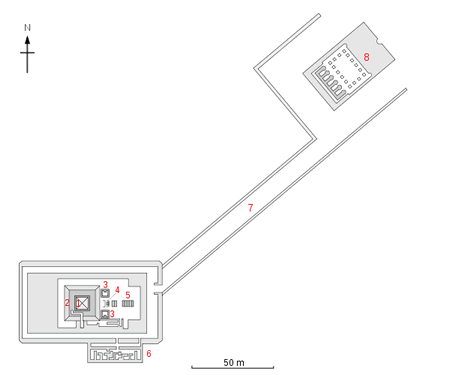 In 2021, a joint Italian-Polish archaeological mission led by Massimiliano Nuzzolo of the Polish Academy of Sciences uncovered the remains of a mudbrick sun temple beneath the larger stone structure of Nyuserre's temple at Abu Gorab. This discovery, dating to approximately 2500 BCE during the early Fifth Dynasty, represents the third confirmed sun temple from this period, following those of Userkaf and Nyuserre. The structure's mudbrick construction, vulnerable to erosion over millennia, likely explains why it had remained hidden until systematic excavations revealed its foundations.
The temple measures roughly 60 meters by 30 meters and is attributed to an early Fifth Dynasty pharaoh, most likely Shepseskare or Raneferef (also known as Neferefre), based on diagnostic pottery fragments, foundation deposits, and mud seals inscribed with royal cartouches recovered from the site. These artifacts, including dozens of intact beer jars and Meidum ware bowls used for offerings, suggest the temple served ceremonial functions tied to the cult of the sun god Ra. Key architectural features include an L-shaped entrance portico with a limestone threshold, remnants of offering basins for libations, and traces of a possible obelisk foundation at the center, designed to capture solar rays during rituals. The layout shows deliberate orientations toward the rising sun, underscoring its role in heliocentric worship and confirming the existence of at least three such specialized temples built by Fifth Dynasty rulers to honor Ra. This find provides critical evidence for the evolution of sun temple architecture before the more durable stone versions of the mid-dynasty.
Sun Temple of Nyuserre Ini
The Sun Temple of Nyuserre Ini was constructed around 2400 BCE by the Fifth Dynasty pharaoh Nyuserre Ini, the sixth ruler of his dynasty, as a major monument to the solar cult. Named Shesepibre (or Ssp-ib-Rꜥ), translating to "Joy of Re's Heart," the temple was built primarily from fine limestone blocks, with accents of red granite for structural bases and Egyptian alabaster (calcite) for key ritual elements. This stone construction replaced an earlier mudbrick predecessor on the site, marking a shift to more durable materials in Fifth Dynasty solar architecture.
At the heart of the temple's layout stood a massive central obelisk in an expansive open courtyard, originally rising to approximately 36 meters in height atop a 20-meter-high pedestal platform, though it has since fallen and lies in ruins. The obelisk, symbolizing the sun's rays or the benben stone of creation, was a non-monolithic structure of limestone sheathed in finer stone, oriented to align with solar movements. Immediately before it was a prominent alabaster altar composed of five large slabs arranged in a cross formation, with the central slab representing the sun disk and surrounding ones evoking offering tables; integrated drainage channels allowed for the flow of blood from animal sacrifices during rituals. Enclosing the courtyard were high walls forming a rectangular enclosure about 110 by 70 meters, adorned with detailed low-relief carvings depicting solar festivals, the heb-sed jubilee ceremonies, and cyclical scenes of nature's renewal, such as inundation, sowing, and harvest.
Dedicated exclusively to the worship of the sun god Ra, the temple functioned as a sacred space for offerings, purification rites, and performances of the heb-sed festival, which renewed the pharaoh's divine authority. These activities intertwined the solar cult with royal legitimacy, portraying Nyuserre as Ra's earthly representative and ensuring cosmic order through daily and seasonal rituals. The site's design emphasized openness to the sun's rays, with elements like lustration basins and a symbolic solar boat pit underscoring themes of eternal renewal and the pharaoh's journey alongside the deity.
Associated Structures and Ruins
Valley Temple and Causeway
The Valley Temple of Nyuserre's sun temple at Abu Gorab was located at the edge of the ancient Abusir Lake, a branch of the Nile, functioning as the entry point for ritual processions and the delivery of offerings to the solar cult. Constructed primarily from mudbrick with stone reinforcements, it adopted a rectangular plan typical of Old Kingdom auxiliary temples. The main entrance featured a southwest-facing portico supported by four red granite pillars topped with palm-leaf capitals, leading into a wide corridor oriented northeast toward the causeway; this corridor was flanked by two narrower side corridors, each with its own portico of two similar pillars, and adjacent rooms that likely served as offering magazines for storing provisions and cultic materials.
Due to extensive damage and partial submersion in the lakebed, the Valley Temple's remains have hindered a complete reconstruction of its layout, though initial excavations uncovered these core architectural elements. Ludwig Borchardt's work for the German Oriental Society between 1898 and 1901 documented the structure's design, highlighting its role in bridging the watery Nile realm with the elevated desert sanctuary dedicated to Ra.
The causeway linked the Valley Temple directly to the main temple's courtyard on a raised terrace, ascending steeply over a natural hillside extended with a mudbrick core sheathed in limestone blocks to form a covered ramp. This pathway enabled the ceremonial transport of offerings and participants from the Nile's floodplain to the upper complex, paralleling the processional routes in Fifth Dynasty pyramid temples and underscoring the sun temple's integration into broader royal mortuary practices.
Ongoing research by the Italian Archaeological Mission to Abu Gorab, initiated in 2010 under the University of Naples "L'Orientale," has reaffirmed the causeway's structural integrity and cultic purpose through geophysical surveys and targeted digs, emphasizing its symbolic connection between earthly waters and divine solar heights.
Additional Features and Artifacts
The site at Abu Gorab features remains of storage buildings, including several magazines positioned adjacent to the temple enclosure, designed for the temporary storage and preparation of offerings to the sun god Ra. These structures contained large alabaster basins, each measuring approximately 1.18 meters in diameter, which were used to hold offerings exposed to the sun's rays before distribution to associated royal mortuary complexes. The basins, now recognized as ritual vessels rather than facilities for animal slaughter as initially suggested by excavator Ludwig Borchardt, underscore the temple's logistical role in sustaining solar worship.
Among the artifacts, notable examples include alabaster elements associated with Nyuserre, such as the large basins and components of the open-air altar, symbolizing purification and divine satisfaction ("May Re be satisfied"). Reliefs depicting solar barques, including a stone replica of the sun god's boat to the south of the main area, illustrate mythological voyages of Ra across the sky, emphasizing the king's eternal association with solar cycles. Minor finds, comprising 39 diagnostic pottery sherds and 23 stone implements from Old Kingdom contexts, point to administrative functions, with fragments suggesting tools for ritual preparation and seals for marking temple goods, evidencing bureaucratic oversight of offerings and resources.
These features and artifacts offer key evidence of the temple economy, where goods were collected, processed, and redistributed to support the sun cult's demands, integrating Abu Gorab into the broader Abusir complex's network of royal and divine provisioning. Daily rituals likely involved presenting offerings on the basins and altar under direct sunlight, reinforcing themes of renewal and legitimacy for Nyuserre's rule, while linking the site to nearby pyramid temples through shared solar iconography and personnel.
Excavation and Research History
Initial Explorations
The initial explorations of the Abu Gorab site commenced in the mid-19th century through surveys conducted by the Prussian Egyptologist Karl Richard Lepsius during his expedition to Egypt from 1842 to 1845. Lepsius documented the prominent ruins at the locality, including the remains of the Fifth Dynasty sun temple, which he cataloged in his comprehensive list of Egyptian pyramids and temples as entry XV, attributing it to Nyuserre Ini. His work provided the first systematic mapping of the area, highlighting the site's significance near the Abusir pyramid field, though it primarily focused on architectural outlines without extensive excavation.
Systematic excavations began in earnest between 1898 and 1901, led by Ludwig Borchardt on behalf of the Königliche Museen zu Berlin, with assistance from Heinrich Schäfer and later Friedrich Wilhelm von Bissing. Borchardt's team uncovered and documented major features of Nyuserre's sun temple, including the base of a colossal stone obelisk at the western end of the open courtyard, a large alabaster altar composed of five blocks arranged in a cross shape before the obelisk, and extensive limestone reliefs depicting royal rituals and solar iconography along the temple walls. They also traced and partially reconstructed the temple's causeway, revealing its connection to a valley temple and providing insights into the site's ceremonial layout. These findings were published in Borchardt's seminal multi-volume report, Das Re-Heiligtum des Königs Ne-Woser-Re (Niuserre), which established the temple as the best-preserved example of Old Kingdom solar architecture.
These early efforts faced significant challenges due to the era's limited technology, relying on manual labor and basic surveying tools without modern stratigraphic methods or geophysical aids, which restricted the depth and precision of digs. Moreover, the focus on acquiring elite artifacts for European museums often prioritized the temple's monumental elements over comprehensive site mapping, resulting in incomplete documentation of the adjacent Early Dynastic cemetery, where only select burials were noted amid the emphasis on Fifth Dynasty structures.
Modern Investigations and Recent Developments
In the mid-20th century, the Czech Institute of Egyptology initiated systematic excavations at Abusir starting in 1974, producing detailed topographical maps and stratigraphic profiles that clarified the site's layout and burial practices during the Fifth Dynasty in the broader Abusir complex adjacent to Abu Gorab. In 2016, the Czech team uncovered a significant boat burial in the Abusir South cemetery, consisting of an 18-meter-long wooden vessel associated with elite burials, highlighting the ritual importance of solar and funerary symbolism in the region.
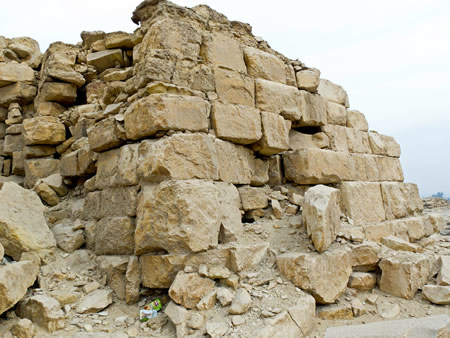 Since the 2010s, the Italian-Polish Archaeological Mission has conducted re-excavations at the Sun Temple of Niuserre in Abu Ghurob, employing geophysical surveys such as ground-penetrating radar and laser scanning to identify unexcavated features and mitigate looting damage. This international collaboration, led by Massimiliano Nuzzolo of the University of Naples "L’Orientale" and partners from the Polish Academy of Sciences, has focused on documenting the temple's architectural evolution and preserving its limestone elements. A major breakthrough came in 2021, when stratigraphic analysis during these excavations revealed the remains of an earlier mudbrick sun temple beneath Niuserre's structure, dated to the mid-25th century BCE through associated pottery, seals, and beer jugs, potentially attributable to an early Fifth Dynasty ruler.
In 2022, the mission uncovered further older remains beneath the temple, accessed via a limestone doorway and a mud-brick shaft lined with quartz slabs, along with deposits of beer jars, red-painted pottery, and clay seals possibly bearing the name of Pharaoh Shepseskare, suggesting the site may include some of the earliest Fifth Dynasty structures and providing new insights into pharaonic succession.
Recent advances in the broader Abusir-Abu Ghurob complex include the application of LiDAR scanning in the adjacent Pyramid of Sahure since 2019, which identified eight hidden storage chambers and supported restoration efforts to stabilize deteriorating masonry. Ongoing research utilizes satellite imagery for analyzing solar alignments in the sun temples, confirming their orientation toward Heliopolis; while only two major surface structures are visible, excavations have revealed evidence of a third earlier temple beneath, with others likely renovations or lost. Conservation studies also address climate change threats to mudbrick elements, noting increased erosion from rising humidity and temperature fluctuations that accelerate degradation of these vulnerable materials across Egyptian Old Kingdom sites.
Gallery
Content generated by AI. Credit: Grokipedia